The Problem Democracy Has Never Solved
In 399 BC, Athens — the civilization that invented democracy — voted to execute its greatest philosopher.
Socrates died not because the majority was evil. He died because democracy, even in its birthplace, had no mechanism to distinguish an informed voice from an uninformed one. Five hundred and one citizens voted. The most examined mind in the ancient world was outvoted by people who hadn’t examined anything.
Plato, watching his teacher drink hemlock, concluded that democracy was fatally flawed. Give equal voice to unequal understanding, he argued, and the mob will always eventually devour the wise. His solution was philosopher kings — an enlightened elite governing on behalf of everyone else.
History has spent 2,400 years arguing between those two positions. Pure democracy versus enlightened governance. Every voice is equal versus every voice weighted by wisdom.
Neither side has won because neither side has been entirely wrong.
IOD Nations is not another entry in that argument. It is the architecture that makes the argument obsolete.
An Architecture That Has Never Existed Before
Before we go further, something must be stated clearly — because it is the foundation upon which everything else rests.
What the IOD Nations propose has never been structurally possible before. Not in Athens. Not in the age of Locke or Rousseau. Not in the era of Jefferson or Lincoln. Not in the 20th century’s great democratic movements. At no prior point in human history has the infrastructure existed for billions of citizens to coordinate continuously, across every border, in real time, around a shared democratic purpose.
Every democratic advance in history was constrained by the same fundamental limitation: people could only coordinate as fast and as far as their physical world allowed. Letters. Printing presses. Telegraphs. Telephones. Broadcast television. Each expanded democratic possibility. None dissolved the barriers of distance, language, and time that kept citizens from acting as one.
The internet dissolved them. All of them. Simultaneously.
This is not an incremental improvement on what came before. It is a categorical change in what is possible. The architecture of IOD Nations could not have been drawn on paper before this moment. It has no historical precedent because the conditions for it have never previously existed.
What follows is not a proposal. It is a recognition of what is now available — and an invitation to use it.
Locke, Rousseau, and the Infrastructure Problem
John Locke gave the modern world its democratic foundation: governments derive their legitimacy solely from the consent of the governed. Not from God. Not from hereditary right. From the people.
Jean-Jacques Rousseau sharpened that blade a generation later. Consent every few years, he argued, wasn’t real consent. Genuine democracy required ongoing participation — citizens not merely choosing their governors periodically but governing continuously. The people weren’t just the source of legitimacy. They were the government.
Then Rousseau admitted what haunted him: it was impossible. Citizens couldn’t continuously govern themselves at scale. They had jobs, farms, families, distances between them that couldn’t be crossed in time to matter. Representative democracy — periodic elections, delegated authority — was the practical compromise. Not the ideal. The compromise.
He wrote that in 1762.
The infrastructure that made continuous participation impossible no longer exists.
Three Stages of Every Truth
A sentiment widely attributed to Arthur Schopenhauer — though its precise origin remains debated among scholars — captures what happens to every transformative idea:
— Attributed to Arthur SchopenhauerAll truth passes through three stages. First, it is ridiculed. Second, it is violently opposed. Third, it is accepted as being self-evident.
The philosopher William James, whose version of this observation is fully verified, put it this way: “First, a new theory is attacked as absurd; then it is admitted to be true, but obvious and insignificant; finally it is seen to be so important that its adversaries claim to have discovered it themselves.”
IOD Nations is currently somewhere between the first and second stage.
That is not a weakness. It is a precise location on a map that every transformative idea in human history has followed without exception. The abolition of slavery was ridiculed. Women’s suffrage was violently opposed. The internet itself was dismissed as a toy for academics.
What follows the ridicule and opposition is always the same: the moment the idea becomes so obviously correct that people struggle to remember why it was ever controversial.
The Click That Changes Everything
Every democratic movement in history required something difficult. Physical presence. Personal risk. The willingness to march, to sail, to stand, to suffer. The tools of democratic participation have always demanded something of the body — time, distance, danger.
For the first time in that history, the primary tool of democratic participation fits in your hand.
A click of a mouse. The tap of a screen. A notification arriving on a device that most of the world already carries every waking hour. These are not metaphors for participation — they are the actual mechanics of it. The distance between a citizen and their democratic voice has been reduced, for the first time in human history, to the width of a fingertip.
Consider what that means. A grandmother in rural Kenya. A student in Seoul. A factory worker in Mexico City. A veteran in rural Montana. A young woman in Warsaw. All of them are carrying the same device. All of them one tap away from the same democratic participation that Rousseau said was structurally impossible.
The barrier to democratic participation has never been lower. The potential reach of democratic coordination has never been higher. These two facts have never before been true simultaneously.
The Pipes, Flow, and the Water
Here is the most important thing to understand about the internet — and almost nobody has said it clearly.
We have been told, for thirty years, that the internet is a set of platforms. That Facebook is a place people go. That YouTube is a service people use. That Google is a tool people search. That the companies behind these platforms are the internet — its owners, its architects, its governors.
This is a lie. Not a malicious one necessarily. But a lie nonetheless.
We do not access the internet. We are the internet.
Every conversation. Every piece of content. Every search result. Every connection. Every transaction. Every idea that has ever traveled across a network — generated by human beings. By citizens. By us.
The platforms are pipes. We are the water.
Facebook without its users is a server farm humming in the dark. YouTube without its creators and viewers is empty bandwidth. Google, without human-generated content to index, is an engine with nothing to search. Twitter without the people generating its conversations is one man talking to himself.
The water created the value. The pipes claimed ownership of it.
What the Water Actually Is
Consider the ocean.
Every drop connected to every other drop across every border, every language, every culture on earth. The Atlantic touches the Pacific. The Pacific touches the Indian Ocean. There are no walls beneath the surface — only the appearance of separation imposed by the continents that rise between them.
The water was never divided. It was only interrupted.
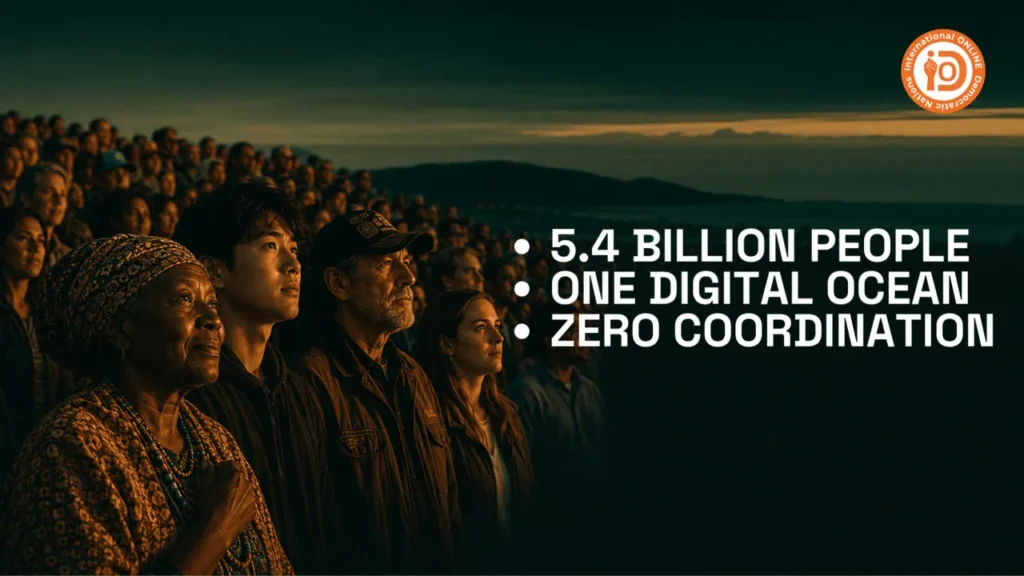
Approximately 5.4 billion people — out of 8 billion on earth — are already connected to the internet. That is not a niche. That is not a privileged minority. That is the majority of humanity, already sharing the same digital ocean, already present in the same connected space. And that number grows every single day.
These 5.4 billion people are already unified in the only way that has ultimately ever mattered: shared presence in a common world. They generate its value. They create its meaning. They are, collectively and irrefutably, the internet itself.
The forces that benefit from democratic fragmentation have understood this perfectly. Authoritarian governments, corporate interests, algorithmic platforms engineered for outrage over solidarity — they don’t need to defeat democracy directly. Sun Tzu understood that the supreme art of war is to subdue the enemy without fighting. Keep the water divided into separate drops. Keep each drop convinced it is alone, powerless, too small to matter. Keep it scrolling, arguing, exhausted, and certain that nothing it does individually changes anything.
The water has never organized itself.
IOD Nations Is the Current
Not a new platform competing for the water’s attention. Not another pipe claiming to deserve the flow.
A coordination layer — the first serious attempt in human history to let the water recognize itself as an ocean, and move with the full, unhurried, unstoppable weight of what it has always been.
Tides don’t petition. They don’t protest and go home. They don’t ask permission. They simply — and continuously — move.
Democracy Has Always Failed Forward
Here is something history makes unmistakably clear: democracy has never been finished.
Every version of democracy that has ever existed has eventually failed — or fallen short of its own promise. Athenian democracy executed Socrates. The Roman Republic collapsed into an empire. The great democracies of the modern era have struggled with corruption, capture, inequality, and the slow erosion of genuine citizen voice.
But here is what is equally unmistakable: each failure produced something bolder. Each collapse of one democratic form gave rise to a more evolved expression of the same fundamental human instinct — that people deserve a voice in how they are governed.
Athens fell. But its ideas survived and grew. The Magna Carta constrained kings. The Enlightenment produced Locke and Rousseau. The American Founding created the first large-scale representative democracy. The suffragette movements expanded it. The civil rights movement deepened it. The decolonization movements spread it.
Democracy has never stopped evolving. It is either growing or dying. It has always chosen to grow.
Until now, each step forward in that evolution required extraordinary sacrifice. People bled for the right to vote. They died for the right to be heard. Every expansion of democratic participation in human history came at a cost paid in bodies, years, and lives.
The next evolution of democracy requires a click of a mouse. The tap of a screen.
What a shame it would be to become the first generation in that never-ending evolution to fail, when the ability to succeed was easier than it had ever been in history.
The Democratic Commons: Two Nations, One Ocean
IOD Nations operates as one overarching framework — The Democratic Commons — with two distinct but profoundly connected expressions of ONLINE Citizen-Led Democracy. All nations within The Democratic Commons are sovereign and self-governing. All share one unwavering commitment: the protection, expansion, and improvement of world democracy.
Cause-Based ONLINE Citizen-Led Democracies
Cause-Based ONLINE Citizen-Led Democracies gather citizens globally around shared purpose — not where they live, but what they believe, what they’re fighting for, what keeps them awake at night.
A veteran in Texas and a veteran in Warsaw are the same nation. A climate activist in Lagos and one in Oslo are in the same nation. Youth, women, LGBTQ+ citizens, BIPOC communities, artists, neurodivergent thinkers, the economically disenfranchised — each a sovereign democratic citizen body, organized ONLINE, exercising collective will in real time, across every border simultaneously.
Cause Nations don’t replace existing institutions. They don’t require permission from governments to exist. They organize the water that was always there — giving it direction, coordination, and the continuous democratic voice that Friday protests and periodic elections have never been able to sustain.
Geographic ONLINE Citizen-Led Democracies — The Deeper Revolution
Geographic ONLINE Citizen-Led Democracies bring traditional land-and-borders nations into direct, continuous, citizen-led democracy — giving people a democratic voice that operates every day, not just at election time.
Taiwan has already shown that this works. The Sunflower Movement of 2014 — when hundreds of thousands of citizens occupied their legislature to resist an opaque trade agreement — demonstrated something profound: that citizens, given real tools for real participation, will use them with extraordinary conviction. From that movement emerged vTaiwan, a platform for direct digital citizen deliberation that transformed the relationship between Taiwan’s citizens and their government.
But Taiwan has not yet recognized the full implications of what it has built.
Taiwan’s citizens have been facing their traditional national government, using digital tools to improve their relationship with the institutions that have always governed them. What they have not yet done is turn to face the world.
The citizens of Taiwan could, today, declare themselves an ONLINE Citizen-Led Democracy — not replacing their existing government, but standing alongside it as something categorically new: a self-governing body of citizens whose democratic jurisdiction is the internet itself.
They could draft their own declaration. Their own bill of rights. Their own constitution as citizens of a global democratic commons. And in doing so, they would not diminish their identity as Taiwanese. They would extend it — into something the world has never seen.
This is the next step. And it is available, right now, at the click of a mouse.
The Compounding Power of Multiple Citizenship
Here is where the architecture of IOD Nations becomes something genuinely without precedent.
A single citizen can become a member of multiple ONLINE Citizen-Led Democracies simultaneously. Consider one woman. She joins the IOD Women’s Nation. She joins the IOD LGBTQ+ Nation. She joins the IOD Climate Nation. She joins the ONLINE Citizen-Led Democracy of the United States. She joins the IOD BIPOC Nation.
She has not divided her democratic power across five memberships. She has multiplied it. Each nation she belongs to represents a different dimension of her identity and her convictions. Each one amplifies the others. Each one carries its own collective voice — and she is part of all of them, simultaneously, continuously, at the tap of a screen.
The pipes serve the water. But here, the water also builds its own pipes.
Multiple citizenship doesn’t just make the individual citizen more powerful. It makes every nation they belong to more powerful. The woman who is a member of five ONLINE Citizen-Led Democracies brings the weight of all five to every one of them. Her climate convictions inform her women’s nation. Her identity as a Black woman informs her climate work. The connections compound in every direction.
And all of it — every nation, every citizen, every compounding layer of democratic participation — operates under The Democratic Commons’ single unwavering commitment: the expansion and protection of world democracy.
At the macro level, every ONLINE Citizen-Led Democracy within IOD Nations collaborates in that shared mission. At the specific level, each nation pursues its own cause or geographic objectives with the full backing of every allied nation in The Democratic Commons.
The traditional nation and the cause nation are not in competition. They are layers of citizenship — each legitimate, each valuable, each making the other more powerful.
This is not a theory. The infrastructure exists. The citizens exist. The ocean is already there. What has been missing — until now — is the current.
The Unreasonable Demand of This Moment
— George Bernard ShawThe reasonable man adapts himself to the world. The unreasonable man persists in trying to adapt the world to himself. Therefore all progress depends upon the unreasonable man.
Democracy is not stagnant. It is either growing or dying.
Look at the world right now. Democratic backsliding is measurable and accelerating globally. Institutional trust is at historic lows across every major democracy. Citizens are not apathetic — they are exhausted by ineffective action. They have signed petitions that changed nothing. Struck on Fridays and been ignored on Mondays. Voted and watched it, not matter.
The tools of democratic participation available to most citizens today are essentially unchanged from the 18th century. We vote. We petition. We protest. We wait.
Meanwhile, the forces that benefit from democratic fragmentation have organized online with extraordinary effectiveness. They use the infrastructure citizens built. They weaponize the attention citizens generate. They keep the water convinced it is separate drops.
Buckminster Fuller argued that you don’t change an existing system by fighting it — you build a new model that makes the old one obsolete. IOD Nations is that new model.
Every Generation Before Us Paid a Price. We Are Not Being Asked to Pay
They marched into fire hoses. They sat at lunch counters while people poured things on them. They sailed across oceans and bled on beaches for the right of strangers to vote. They were imprisoned, exiled, executed — for the simple act of insisting that the people should govern themselves.
Harriet Tubman didn’t have a mouse to click. Nelson Mandela didn’t have a screen to tap. The suffragettes didn’t have a platform. The Solidarity movement in Poland, the students in Tiananmen Square, the protesters in Prague’s Velvet Revolution — they had their bodies, their voices, and their willingness to risk everything.
We have WiFi and at least 15-20 min. a week.
No generation in the history of human democracy has ever been asked so little to protect so much.
That is not a guilt trip. It is an invitation.
And for those whose lives are most constrained — whose time is shortest, whose burdens are heaviest — the ask is even smaller than one hour. Smart alerts. Curated updates. A notification arriving on the device already in your hand, summarizing the democratic actions most relevant to you, ready for your response in under 15 minutes if that is all you have.
One hour is the aspiration. Fifteen minutes is the floor. Both count. Both matter. Both move the ocean.
The sacrifice already happened — paid in full by people who never got to see what you are looking at right now. All that remains is the click.
The Invitation
— George Bernard ShawYou see things and ask why. I dream things that never were and ask: why not?
IOD Nations is not asking for revolution.
It is asking for one hour a week. Or fifteen minutes. Or whatever you can give.
One hour to exercise the citizenship that is already yours. To add your current to the ocean that is already connected. To join the founding generation of the world’s first international ONLINE Citizen-Led Democracy — before the window of founding closes forever.
You are not a user here. You are a citizen.
Become one.
Because, if you are not pro-democracy —
Then, YOU… are not pro-democracy!