
— Joel Koman, Founder, IOD NationsDemocracy is never stagnant. It’s either thriving or dying.
IOD Nations Mission Statement
IOD Nations (International Online Democratic Nations) operates under The Democratic Commons: every ONLINE Citizen-Led Democracy, whether Cause-Based or Geographic, is sovereign, distinct, and self-governing, while united in protecting, expanding, and improving world democracy. There are two expressions of this model. Cause-Based Nations organize around a shared global purpose. Geographic Nations organize around land and borders, with continuous direct participation from citizens.
One citizenship. One platform. Infinite entry points.
The core formula: N × C = D, where N is the Number of people united, C is their Collaboration skills and effectiveness, and D is the Democracy that results.
— Buckminster Fullerou never change things by fighting the existing reality. To change something, build a new model that makes the existing model obsolete. Dare to be naive. We are intended to be architects of the future, not its victims.
The Numbers Don’t Lie
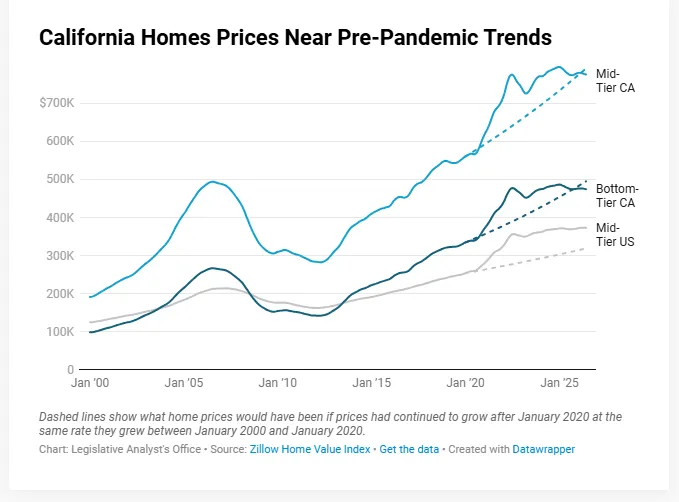
California just got ranked the third worst state in the country to move to in 2026, landing at No. 48 out of 50 overall, dragged down by dead-last marks for affordability, according to ConsumerAffairs’ state ranking. Weather, coastline, culture: none of it is enough to offset the math anymore.

That math is stark. A UC Berkeley and California Policy Lab study tracking the same households over nearly a decade found that Californians who leave the state end up paying $672 less per month in housing costs, and are 48% more likely to own a home within seven years of moving. That is not a lifestyle preference. That is people voting with their moving trucks.
Meanwhile, the state’s own Legislative Analyst’s Office reports that as of June 2026, the estimated monthly cost of owning a typical two-bedroom home in California, including mortgage, property tax, and insurance, runs about $4,600, compared to roughly $2,700 to rent the same home, a 66% ownership premium that has widened in 35 of California’s 48 tracked counties since 2020, according to the LAO’s Housing Affordability Tracker.
And now there is a third pressure stacking on top of taxes and housing: insurance.
The Insurance Market Is Breaking in Real Time
This is not a slow-moving trend. It is a market in visible distress.
The FAIR Plan, California’s insurer of last resort, has exploded from covering about 1.5% of the state’s single-family homes in December 2020 to roughly 5% by March 2026, according to Stanford’s Climate and Energy Policy Program. More than one in every 17 new home loans in California is now being written with FAIR Plan coverage as the only option available, a bare-bones policy that covers little beyond fire, smoke, lightning, and explosion. Average statewide deductibles climbed from $1,813 to $2,553 over that same stretch.

The trigger event was catastrophic. The January 2025 Palisades and Eaton fires in Los Angeles produced insured losses estimated between $25 billion and $45 billion, according to reinsurance industry analysis, pushing a system that was already strained past the breaking point. State Farm, California’s largest homeowners insurer, had already announced plans to non-renew roughly 30,000 homeowner and rental dwelling policies in 2024 (72,000 including commercial apartment policies), and Tokio Marine and Trans Pacific Insurance exited the state entirely that same year, according to State Farm’s own announcement.
Auto insurance tells the same story from a different angle. California’s top 10 insurers raised rates by an average of 13% in 2023, 15.4% in 2024, and 6% in 2025, with carriers representing about 85% of the state’s auto policies raising rates by more than a third since 2023, per S&P Capital IQ data. By early 2026, the average annual full-coverage policy in California ran close to $2,368, according to Insurify’s 2026 market data.
Stack it up: a household paying more to own than to rent, watching their auto premium climb faster than their paycheck, and opening a renewal notice only to learn their home insurer has walked away entirely. That is not three separate problems. It is one affordability crisis wearing three different masks.
When Citizens Stop Waiting, Things Actually Change
Here is what the insurance crisis also proves: organized citizens can move mountains that legislatures won’t.
In 1991, a Northern California wildfire destroyed roughly 3,000 homes and exposed how badly underinsured families were, and how adversarial the claims process could be. Out of that disaster, homeowner Amy Bach co-founded United Policyholders, a nonprofit built by and for policyholders, not insurers or trial lawyers.
It was not a lobbying firm. It was residents who had been burned, literally and financially, deciding they were done being outmatched by an industry with armies of lawyers and lobbyists.
The results speak for themselves. After the 2017 and 2018 California wildfires, United Policyholders’ advocacy helped shape a package of reforms that now guarantees disaster survivors up to 36 months of extended living expense coverage, lets policyholders combine limits across different coverage categories to actually rebuild, and protects victims from losing coverage in the middle of recovery, according to reporting on the organization’s legislative record. Their advocacy also helped drive SB 824, the state law mandating a one-year moratorium on insurers cancelling or non-renewing policies in ZIP codes hit by a declared wildfire emergency, a protection that shielded thousands of Los Angeles homeowners after the January 2025 Palisades and Eaton fires.
None of that came from Sacramento waking up on its own. It came from citizens who organized, showed up at hearings, and refused to be outnumbered in rooms where decisions about their homes were being made without them.
That is the proof of concept. Citizen-led organizing works. The problem is that it took a burned-down town to build it, it stayed confined to one issue, and it still depends on volunteers fighting an uphill, ZIP-code-by-ZIP-code battle against an industry with unlimited resources.
This Is Exactly the Gap IOD Nations Exists to Close
Imagine that same energy, the kind that forced insurance reform after a disaster, organized permanently instead of reactively. Not waiting for the next fire, the next non-renewal wave, the next rate filing, to mobilize. Built as standing digital infrastructure that citizens can activate the moment a system starts failing them, whether the issue is insurance, housing, taxation, or the next crisis nobody has named yet.
That is the premise behind IOD Nations. If a business no longer requires brick and mortar, a nation no longer requires land and borders. A Cause-Based Nation built around economic and consumer protection could organize renters, homeowners, and drivers across every California ZIP code (and beyond) into one coordinated, digitally native voice, permanently online, permanently ready, instead of one that has to be rebuilt from scratch after every disaster.
N × C = D. The Number of people united, multiplied by their Collaboration skills and effectiveness, produces Democracy that actually delivers outcomes. United Policyholders proved what a few thousand organized citizens can force out of a hostile system. IOD Nations is the infrastructure to scale that model to millions, across every cause where citizens are being priced out, denied coverage, or simply ignored.
California’s affordability crisis will not be solved by residents individually shopping for a slightly cheaper insurer, or moving to Texas one household at a time. It will be solved the way it always has been: citizens organizing, showing up, and refusing to be outnumbered. The only question is whether that organizing stays local and reactive, or becomes a permanent, connected, citizen-led democracy built for the next fight before it starts.
Join the Movement
- Website: iodnations.org
- Take Civic Action: iodnations.org/civic-action
- Weekly Live Show: Every Wednesday, 11 AM PST via Zoom (link goes live at show time): https://us06web.zoom.us/j/83881921499
- Contact: hello@iodnations.org