Democracy is never stagnant. It’s either thriving or dying.” — Joel Koman, Founder, IOD Nations
ABOUT IOD NATIONS
IOD Nations is a name for the vision of an undeniable, bold new architecture for world democracy, one that was simply never available to the citizens of the world before the internet. It operates under a single overarching framework: The Democratic Commons. Within it, every ONLINE Citizen-Led Democracy, whether organized around a shared cause or a geographic nation, is sovereign, distinct, and self-governing. What unites them all, without exception, is one unwavering macro-level commitment: the protection, expansion, and improvement of world democracy, for as many people, in as many ways, as possible.
IOD Nations consist of two expressions: Cause-Based ONLINE Citizen-Led Democracies, which unite citizens globally around shared purpose regardless of where they live, and Geographic ONLINE Citizen-Led Democracies, which unite citizens of traditional land-and-borders nations in continuous direct democratic participation. One citizenship. One platform. Infinite entry points. All of it is available at the click of a mouse or the tap of a screen.
— — Buckminster Fuller“You never change things by fighting the existing reality. To change something, build a new model that makes the existing model obsolete. Dare to be naive. We are intended to be architects of the future, not its victims.”
IOD Nations | iodnations.org | Make Democracy Offensive… NOT Anonymous™️
N × C = D — Nations × Citizens = Democracy
Note to Readers
This article is drawn from a landmark TED Talk by political technologist Ed Birkett, cross-referenced with current civic research and the founding principles of IOD Nations. Every claim is sourced. Every statistic is live. Every problem identified below has a solution, and it begins with you joining us ONLINE.
We are pleased to offer this article free of charge, as we believe in the importance of sharing knowledge and fostering dialogue around the establishment of citizen-led democratic nations. Any assistance, feedback, or insights you can provide would be greatly appreciated as we embark on this journey. We value your expertise and are eager to collaborate on building our first online citizen-led democratic nation.
The Internet Was Always Meant to Be Democratic. Something Went Wrong.
On April 25, 1963, a man named J.C.R. Licklider — director of ARPA’s Information Processing Techniques Office — sent a memo from his office at the Pentagon. He addressed it to the “Members and Affiliates of the Intergalactic Computer Network.”
Licklider’s memo was one of the founding documents of what would become the internet. And even then, at the very moment of conception, Licklider wasn’t just thinking about machines talking to each other. He was thinking about people.
He wrote, reflecting on the network’s potential, that computers would allow “decisions in the public interest but also in the interest of giving the public itself the means to enter into the decision-making process that will shape their future.”
Read that again.
The internet was not invented as an advertising platform. It was not invented as an echo chamber. It was invented to give ordinary citizens a direct hand in the decisions that govern their lives.
Sixty-three years later, we are all members of Licklider’s Intergalactic Network — and his vision has never been further from reality.
America Is the Case Study in What Went Wrong
The numbers are not a political opinion. They are a four-alarm fire.
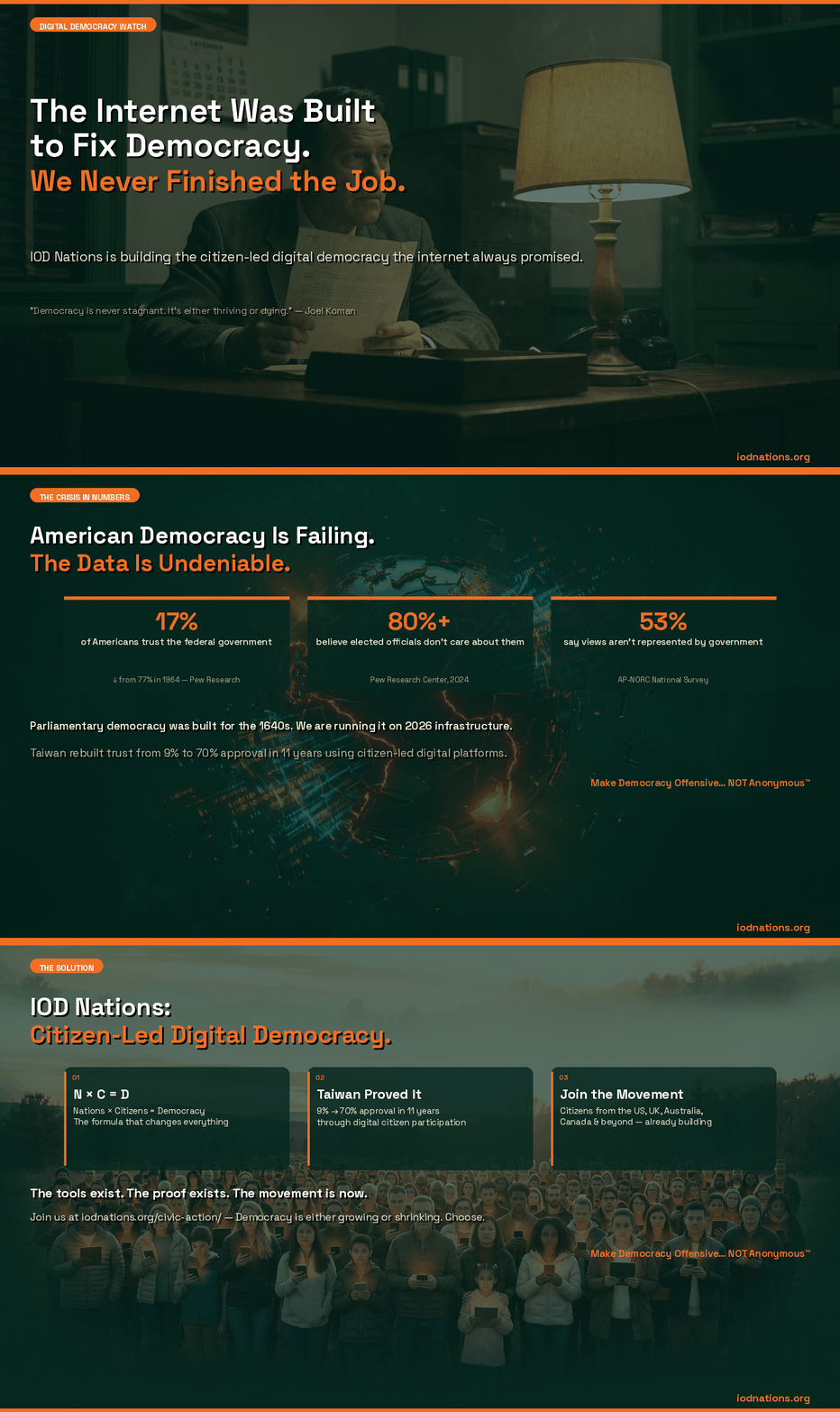
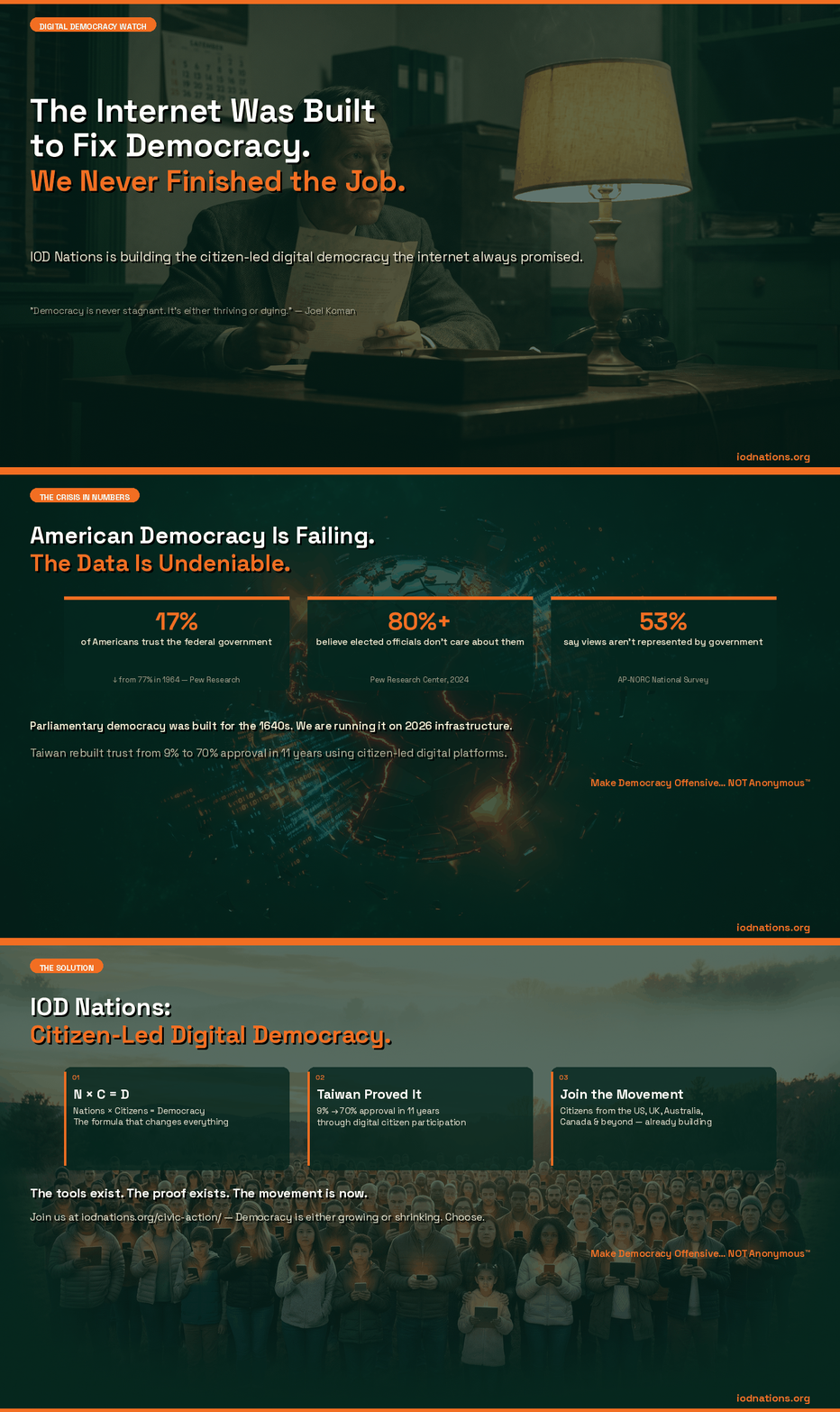
According to Pew Research Center, only 17% of Americans now say they trust the federal government to do what is right “just about always” or “most of the time.” In 1964, that number was 77%. In 1958, it was 73%.
More than 80% of Americans believe elected officials don’t care what people like them think. Seven in ten say ordinary people have too little influence over the decisions Congress makes. And 53% of Americans say their views are not represented well by the government.
In focus groups conducted by Pew, Americans who had tuned out of politics weren’t cynical — they were accurate. One Georgia woman put it plainly: “It’s self-interest on both sides. From the lobbyists, from the politicians, to make it the way they want instead of the way we want.” A Wisconsin man added: “Both sides are trying to say democracy is under attack, but they’re trying to just point at the other side.”
Voter turnout in the United States hovers around 60% in presidential elections and 40% in midterm elections, lower than in most established democracies. Gallup reports that trust in politicians now sits at 41%, with trust in news media hitting a new all-time low of 28%.
This is not a partisan crisis. It is a structural one. And the structure has a name: parliamentary democracy built for the 1640s, running on the infrastructure of 2026.
The System Was a Workaround. The Workaround Expired.
Before parliaments, there was a practical problem: too many people, spread over too vast a land, too busy, too ungovernable, to rule directly. Representative democracy — the idea that citizens would elect proxies to make decisions on their behalf — was an elegant solution to that constraint.
The keyword is was.
The practical obstacles that made direct democracy impossible in 1649 no longer exist. You don’t need to travel to a capital city. You don’t need to be in the same room. You don’t need to belong to a party. You have a phone in your hand that connects you to every other citizen on Earth.
And yet: the system hasn’t changed. Citizens still vote once every two to four years. Still watch from the sidelines. Still waiting for politicians to interpret their will — and consistently watch politicians serve someone else’s.
We built the most powerful communication network in human history and handed it to ad companies and political operatives. We are paying and rewarding them as they refuse to promote freedom and democracy or even worse as they knowingly distract us or deter us from strengthening and protecting our freedoms and democracies! We are doing this to ourselves by paying them and supporting them.
What happened to democracy on social media isn’t accidental. It’s structural. Rather than connecting citizens to governance, platforms built engagement loops around outrage. Instead of empowering civic action, they built tribal identity. Instead of enabling collective decision-making, they produced echo chambers — closed loops of confirmation bias masquerading as political discourse.
The internet changed where we shop, how we fall in love, and how we consume entertainment. It barely touched our role as citizens…because we have opted out on collaborative self-determination, self governance.
But things are changing all across the world!
One Country Proved the Alternative Works
While American trust in government collapsed from 77% to 17%, Taiwan took the opposite path.
After the 2014 Sunflower Movement — a citizen uprising demanding transparency in government — Taiwan made a choice. Instead of suppressing civic energy, it channeled it. The government launched vTaiwan — an open consultation platform powered by Pol.is, a consensus-building tool that allows citizens to surface shared positions across lines of difference.
Government approval ratings went from 9% to 70%
Over 50% of the population now uses digital platforms for policy co-creation
Historically deadlocked issues — including how to regulate Uber, online alcohol sales, and data privacy — were resolved through citizen deliberation in weeks, not years
Taiwan achieved one of the world’s most effective COVID-19 responses without a full lockdown, in part because of its participatory governance infrastructure
The Pol.is platform works differently than social media. There are no replies — only statements, which participants agree, disagree with, or propose themselves. This design eliminates abuse, cuts tribalism, and forces consensus across divides. Instead of amplifying the loudest voices, it surfaces the statements with the broadest support across all groups.
Taiwan did not invent a utopia. It built a functional, scalable model of digital citizen participation — and it worked.
The United States has 335 million citizens and the same internet Taiwan has. The tools exist. The proof exists. What has been missing is the movement.
IOD Nations: The Next Model
— Joel Koman, Founder, IOD Nations“Democracy is never stagnant. It’s either thriving or dying.”
IOD Nations — International Online Democratic Nations — was founded on a premise that takes Licklider’s original vision and makes it operational for the 21st century.
The premise is this: we don’t access the internet. We are the internet. Every click, every login, every piece of data generated by citizens — that is the power. The platforms need us. We don’t need the platforms.
IOD Nations is building what Taiwan built — adapted for a global citizen movement that operates outside the boundaries of any single government. A citizen-led, decentralized, participatory democratic structure where:
Citizens submit and vote on ideas through an AI-moderated governance platform
Issues that reach critical mass demand an institutional response
Sub-nations organize around specific causes — IOD Women’s Nation, IOD Art Nation, IOD Climate, IOD Ukraine, IOD Press, IOD Law, and more
Coordinated, strategic campaigns replace passive scrolling
The mission is not commentary. It is a construction.
The model is already proving itself. Coordinated email campaigns targeting specific institutional actors — from union pension boards to attorneys in high-profile accountability cases — are being organized in real time through live sessions with citizens from the United States, Canada, the United Kingdom, Australia, Germany, India, and beyond.
This is not a petition. It is not a hashtag. It is the beginning of an organized citizen infrastructure — the political equivalent of what Taiwan built, except it answers to no single government. It answers to citizens.
What ONLINE Democracy Actually Requires
Licklider saw it in 1963. Taiwan proved it in 2015. The lesson is not complicated:
Democracy doesn’t fail because people stop caring. It fails because the infrastructure for participation was never built.
People are exhausted, not apathetic. 65% of voters say that thinking about politics makes them feel exhausted most of the time. 55% say it makes them angry. The emotion is present. The channel is absent.
What IOD Nations builds is the channel:
Direct citizen participation — not through elected proxies who answer to donors, but through platforms where citizens vote directly on issues that matter to them
Cross-partisan framing — not left vs. right, but citizens vs. a system that has stopped serving either side
Coordinated action — not passive awareness, but organized, measurable campaigns with defined objectives and real accountability
A scalable model — built on the same Pol.is consensus infrastructure that moved Taiwan from dysfunction to function
The question is not whether this model works. The question is whether Americans will move before the window closes.
The Urgency Is Not Rhetorical
Parliamentary democracy is not failing slowly. It is failing in real time and in full view.
67% of Americans consider their government corrupt. Trust in elected officials has dropped 23 points since the 1970s. Only 4% of Americans believe the political system is working well. Citizens from across the ideological spectrum — in focus groups, polls, and live sessions — say the same thing: “It’s never about us.”
This is the crisis that Licklider foresaw and that Taiwan solved. Not by replacing democracy — but by completing it.
Representative democracy was always a workaround. The internet was always supposed to make it obsolete. The only thing left is the decision to build the replacement.
IOD Nations is building it. Now.
The Formula Is Simple
N × C = D — Numbers of Citizens X Collaboration = Democracy
You are the N. You are the C. The D only works when the Numbers Collaborate Democratically!
Join the movement at iodnations.org. Take your first civic action at iodnations.org/civic-action/. Contact us at: hello@iodnations.org
“Democracy is never stagnant. It’s either thriving or dying.” —
Sources & Further Reading
Licklider’s 1963 Intergalactic Computer Network memo — History of Information
More than 80% of Americans believe elected officials don’t care — Pew Research Center
Americans Widely Pessimistic About Democracy — PBS NewsHour / AP-NORC
State of Public Trust in Government 2025 — Partnership for Public Service
Taiwan’s Digital and Participatory Democracy — DEAL / Doughnut Economics
Taiwan’s System for Crowdsourcing Laws — MIT Technology Review
Lessons from Consensus Building in Taiwan — Democracy Technologies
Taiwan: Grassroots Digital Democracy That Works — RadicalxChange
Tuning Out: Americans on the Edge of Politics — Pew Research Center