They built the most advanced citizen-led governance model in the world — and then stopped at their own border. Here’s the leap Taiwan, Australia, and every democracy is missing.

Based on: Dr. Florian Schneider · AIIA Webinar | Joel Koman · IOD Nations Meritocracy Manifesto | 2026 Research Review
Democracy is not a destination. Democracy is NEVER stagnant, Democracy is either advancing or retreating — and right now the citizens who already hold the power to advance it globally are sitting on the most underutilized force in human history.
This read begins with education but the real beginning is at the end, (Think like Buzz Lightyear) “ Chapter 4 and Beyond! Aspiration! “
Chapter 01 — What Taiwan Built: The World’s Most Advanced Proof of Concept for Digital Democracy
In 2014, Taiwan’s Sunflower Movement did something extraordinary. Students and citizens physically occupied parliament to challenge a trade deal pushed through without consultation and won. But more importantly, they didn’t stop there.
The movement’s aftermath produced a living laboratory for digital democracy. A civic hacker collective called g0v (”gov-zero”), working alongside then-minister Jaclyn Tsai and later led by digital minister Audrey Tang, built something no democratic government had ever built at scale: a functioning pipeline from citizen voice to government action, powered by open-source technology.
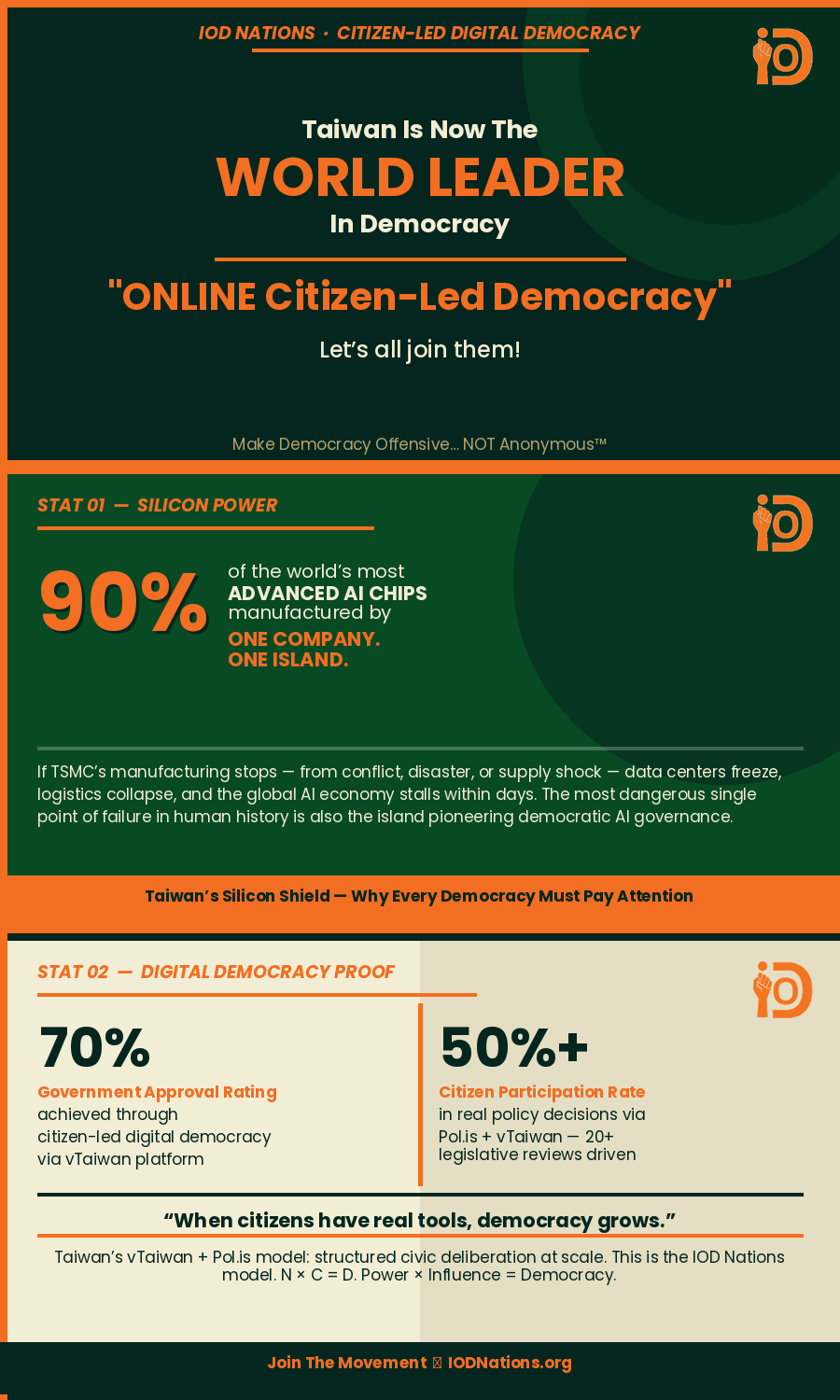
80% of vTaiwan policy cases resulted in decisive government action · 13,853 citizen proposals submitted on the JOIN platform as of 2022 · 30+ major policy cases resolved through vTaiwan open consultation · 50%+ of Taiwan’s 24 million citizens have participated in digital democracy processes
The Architecture: How It Works
Taiwan’s model rests on three interlocking layers. First, vTaiwan — a deliberative process using the AI-assisted consensus tool pol.is to surface areas of shared agreement across polarized groups, without the toxic reply-thread dynamics that destroy most online discourse. There are no downvotes. No rage-bait. Only convergence.
Second, the JOIN platform a government-operated portal where any citizen can submit a policy proposal. Cross 5,000 signatures and the government is legally obligated to respond. Over 289 proposals have triggered formal government responses.
Third, radical transparency Audrey Tang’s team livestreams negotiations, publishes all minutes, and physically travels to city halls across the country to bring the technology to people who aren’t online. As Dr. Florian Schneider of Leiden University documented in his 2019 fieldwork: “You don’t have to be digitally literate in order to participate.”
— Dr. Florian Schneider · AIIA Digital Democracy WebinarDesign matters. You can design for certain outcomes. Taiwan understood that you can build technology that facilitates civic engagement not just transmits it.
The Mimetic Strategy: Fighting Misinformation with Humor
Taiwan’s government also developed what researchers call a mimetic approach to disinformation using memes, humor, and self-deprecating content to neutralize viral falsehoods within hours of their spread. Rather than issuing formal corrections that harden positions, Taiwan’s ministries respond with wit, making the misinformation seem silly rather than dangerous.
The tool: a Line chatbot (Cofacts) that lets citizens flag suspicious messages for crowdsourced fact-checking leveraging Taiwan’s dominant messaging platform to fight the same disinformation circulating on it. The OECD cited Taiwan’s approach as a benchmark model for democratic resilience.
Key Insight: Taiwan’s government approval ratings rose dramatically estimates tracking from single-digit trust levels toward 70%+ reported satisfaction with digital governance initiatives driven not by political rhetoric but by a system that actually listens and acts. This is the proof-of-concept the world hasn’t fully absorbed yet.
Note to Readers
We are pleased to offer this article free of charge, as we believe in the importance of sharing knowledge and fostering dialogue around the establishment of citizen-led democratic nations.
Any assistance, feedback, or insights you can provide would be greatly appreciated as we embark on this journey. We value your expertise and are eager to collaborate on building our first online citizen-led democratic nation.
Chapter 02 — The Missing Layer: Taiwan Has Proven It. But They Stopped at the Border.

Here is what every analysis of Taiwan’s digital democracy model misses. And it is the most important thing.
Everything Taiwan built vTaiwan, JOIN, the Cofacts bot, the mimetic anti-disinfo strategy is pointed inward. It is a sophisticated, proven system for making Taiwan’s government more responsive to Taiwan’s citizens. That is remarkable. That is worthy of global study.
But Taiwan has already united more than half of its 24 million citizens online. They have already demonstrated that digital civic infrastructure can achieve overwhelming participation. They have already proven the model works.
And then they stopped. They pointed out that unified citizen power at their own government’s inbox.
What if the citizens of Taiwan took that unity that proven collaborative infrastructure and projected it internationally as a separate sovereign force? Not Taiwan the government. Taiwan the Citizen Nation.
The g0v model shows that citizens, not governments, are the architects of this movement. The model doesn’t belong to any nation-state. It belongs to the world’s pro-democracy citizens. Taiwan has already built the proof. They are sitting on the launch pad and haven’t realized the rocket is fueled.
That is the magic sauce they haven’t yet tasted. Not “how do we improve our own government” but “we are already united, and we can now move as an international force.”
Chapter 03 — Australia’s Gap: Australia Is Watching. But Watching Is Not Moving.
Australia’s Australian Institute of International Affairs hosted Dr. Schneider’s analysis precisely because Australia recognizes the gap. The country has issued a Third Open Government Partnership National Action Plan, established a Strengthening Democracy Taskforce, and the Grattan Institute’s 2025 report “For the People” confirmed that democratic engagement beyond voting remains dangerously low.
The 2025 Digital Citizen Report found Australians are abandoning government digital services in favor of generative AI a signal that citizens are hungry for responsive, intelligent civic infrastructure but the government hasn’t built it.
53% of OECD citizens believe the political system doesn’t give them a meaningful voice (2024 OECD Trust Survey) · Civic participation beyond voting in Australia: LOW confirmed by Grattan Institute 2025
The Pattern: Study, Admire, Delay
Dr. Schneider noted that Audrey Tang has visited the Netherlands and other democracies. The ideas land well. Audiences are enthusiastic. And then — mostly nothing happens at scale. The reason is structural: governments want to own the solution. They want a government-led digital participation platform. A Ministry of Digital Affairs. A taskforce.
Taiwan’s actual secret is the opposite. The power came from citizens who moved first, built the tools themselves through g0v, and then the government had to respond. Australia is waiting for the government to build the thing citizens should be building.
Australia’s Real Gap: Australia’s democracy challenge isn’t a technology deficit. It’s a sovereignty deficit. Citizens haven’t yet claimed their role as the primary architects of civic infrastructure. The government-first orientation means Australia will always be one election cycle behind.
Australia has one of the highest internet penetration rates in the world, a technically literate population, active civil society, and a shared cultural commitment to democratic norms including deep alignment with Taiwan on the question of Indo-Pacific democratic resilience against authoritarian influence. The ingredients are there. The recipe is missing.
Both Taiwan and Australia are having an internal conversation about better governance. Neither is yet having the external conversation: What if our united citizens became a sovereign international democratic force?
Chapter 04 — The IOD Nations Framework: The Leap From Internal Governance to International Citizen Sovereignty
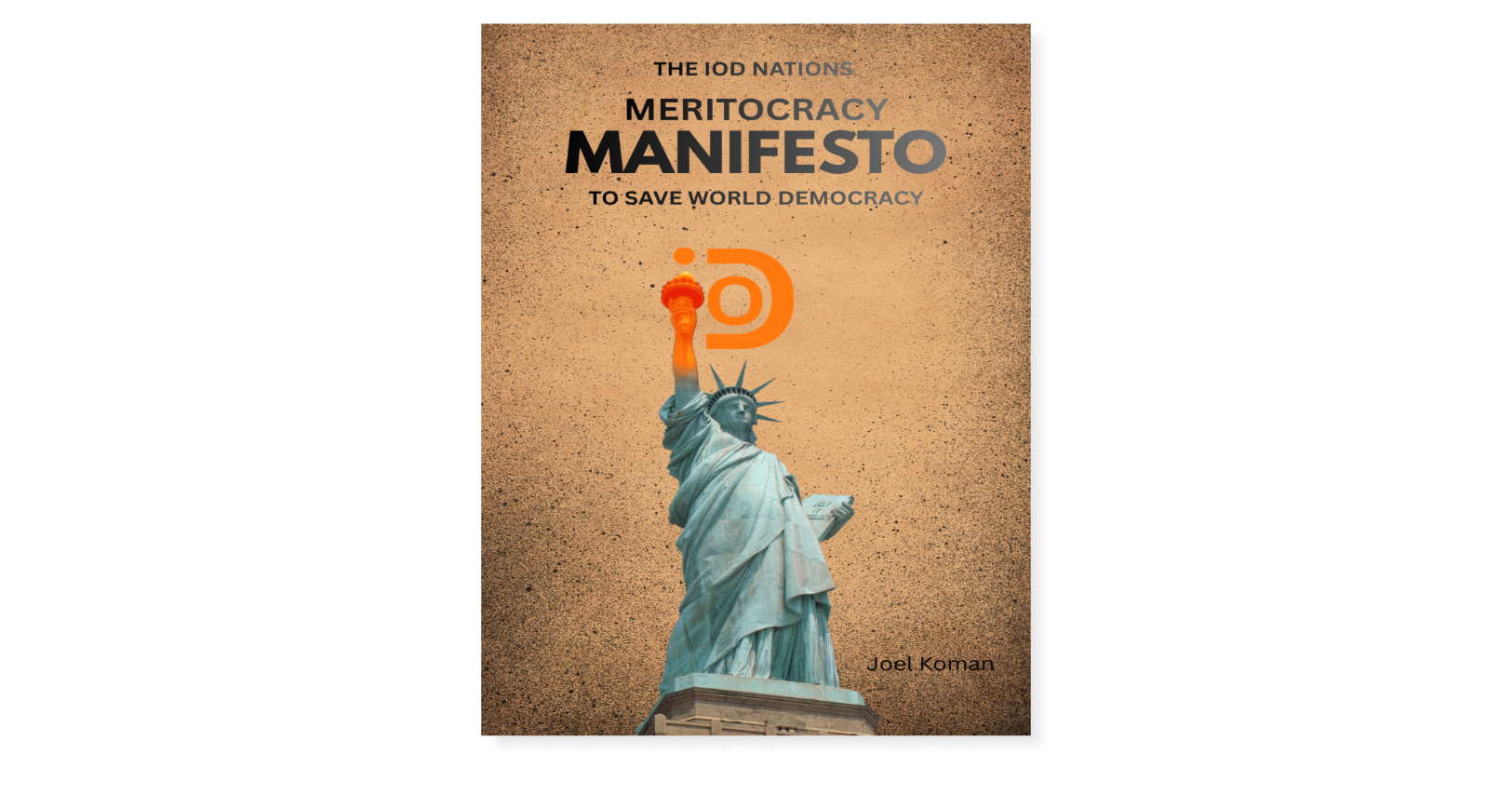
The IOD Nations Meritocracy Manifesto a structured AI-driven dialogue authored by Joel Koman — cuts directly to the premise both Taiwan and Australia have circled without landing on:
— Joel Koman · IOD Nations Meritocracy Manifesto, Chapter 2The internet is now the dominant influencer of human change. It is almost exclusively authoritarian in foundational structure. And we the pro-democracy citizens of the world are its primary source of value. We are not accessing the internet. The internet is accessing us.
Taiwan proved that a networked citizen body not a government can be the primary driver of democratic infrastructure. The Manifesto extends that insight to its logical global conclusion: citizens who are already united online can constitute a new form of sovereign nation one without land borders, military aggression vulnerabilities, or the corruption lag that plagues every physical government.
What IOD Nations Adds That Taiwan’s Model Lacks
1. International Projection of Citizen Power Taiwan’s citizen body can move from internal governance improvement to international democratic force by constituting itself as a separate Online Democratic Nation operating alongside, not inside, Taiwan’s government. The IOD Taiwan Nation would be accountable to citizens globally who share democratic values, not just to Taipei’s bureaucracy.
2. Strategic Boycotts as Non-Military Leverage As the Manifesto demonstrates through AI dialogue, a unified pro-democracy citizen body can execute strategically targeted boycotts against authoritarian platforms and entities — costing them the users who constitute their entire value. One coordinated action against one major platform creates a ripple effect that changes industry-wide behavior. Taiwan’s citizens have already demonstrated the coordination infrastructure to do this.
3. Replacing Military Deterrence with Economic Sovereignty The Manifesto argues compellingly that IOD Nations cannot be invaded militarily. They have no land to take. Their citizens are distributed globally. Their leverage is economic and informational. For Taiwan specifically, surrounded by authoritarian military pressure, this reframes the entire defense posture: a globally unified IOD Taiwan Nation operating internationally is harder to threaten than a 36,000 km² island.
4. Maslow Reframed: Democracy as a Physiological Need The Manifesto’s most powerful philosophical move: freedom and democracy are not just political preferences they are foundational physiological needs that determine access to all other needs (food, water, shelter, safety). Citizens in authoritarian environments don’t lack democracy because they don’t want it. They lack it because no one has built the infrastructure for them to seize it. World Values Survey data consistently shows 70–90% of people globally prefer democratic governance when given informed choice.
5. The First Step Is Embarrassingly Simple Sun Tzu: Opportunities multiply as they are seized. The Manifesto is direct: the first action is not building a platform. It is a unified signal pro-democracy citizens sending one coordinated message to one international body (NATO, the UN, the EU Parliament) as a demonstration of mass unity. That single act, at scale, rewrites the calculus of who holds power online.
Chapter 05 — The Bottom Line: The Question Is No Longer Can It Work. The Question Is Who Moves First.

Taiwan answered “can it work” in 2014 and spent the next decade proving the answer is yes. Their digital democracy model is not theoretical. It produced legislation, reversed policy, built institutional trust, and gave the world open-source tools anyone can replicate today.
Australia is watching and producing reports. The rest of the democratic world is holding conferences. The IOD Nations Manifesto is asking a more urgent question: Why are pro-democracy citizens still waiting for their governments to lead something the citizens themselves are capable of launching this afternoon?
The authoritarian internet Facebook, TikTok, Weibo, the CCP’s information apparatus didn’t wait for government permission to consolidate power. It moved, built, scaled, and is now the dominant infrastructure of human attention. As the Manifesto’s AI dialogue confirms: the internet is almost entirely authoritarian in foundational structure, and we the users are its only source of value.
— IOD Nations Framework · Meritocracy Manifesto, 2024Half of Taiwan’s population is already united online. If they decide to take that unity and make it a separate entity outside and away from Taiwan — implementing the power and influence of Taiwan’s citizens in an international and virtual manner across the world that is the magic sauce they haven’t yet realized they can do.
Taiwan, Australia, the Netherlands, and every functioning democracy have the same latent asset: citizens who are already online, already believe in democratic values, and already outnumber every authoritarian state’s digital apparatus.
The g0v civic hackers didn’t ask Taiwan’s government for permission. They built it and the government had to catch up. The IOD Nations framework proposes the same logic at global scale: don’t petition the old world for reform. Build the new world that makes it obsolete.
Bucky Fuller said it first. Taiwan demonstrated it. The Meritocracy Manifesto is the architecture. The citizens are the nation. The screen is the border. The tap is the vote. The time is now.
Sources & Further Reading: g0v Civic Hacker Movement, Taiwan · vTaiwan Official Platform · pol.is Consensus Technology · JOIN Citizen Policy Platform · Cofacts Fact-Checking Bot · European Democracy Hub: Taiwan · Grattan Institute: For the People (2025) · RadicalxChange: Taiwan Grassroots Digital Democracy · OECD: Citizen Participation in the Digital Age · Harvard BiGS: Audrey Tang Interview
IOD NATIONS · International Online Democratic Nations · Meritocracy Manifesto by Joel Koman · Democracy is never static. It is advancing or retreating. Choose.
👇 Tap The Image To Read “The IOD Nations Manifesto To Save World Democracy”