How Taiwan Built the Democracy the World Is Desperately Searching For and What IOD Nations Must Do Next
By IOD Nations
Democracy is not failing because citizens stopped caring. It is failing because no one built the right tools until Taiwan did.
Thirty years. That is how long freedom and democracy have been documented to shrink worldwide. Thirty years in near-perfect correlation with the rise of the internet. Not because the internet is the enemy, but because authoritarian forces claimed it first, while pro-democracy citizens handed it over without a fight.
Taiwan fought. And what happened next is not a miracle. It is a blueprint.
This is the story of a prophet who saw it coming, the reality you are already living, and the digital solution that already exists waiting to be scaled.
Alexis de Tocqueville Warned Us. Taiwan Answered Him.
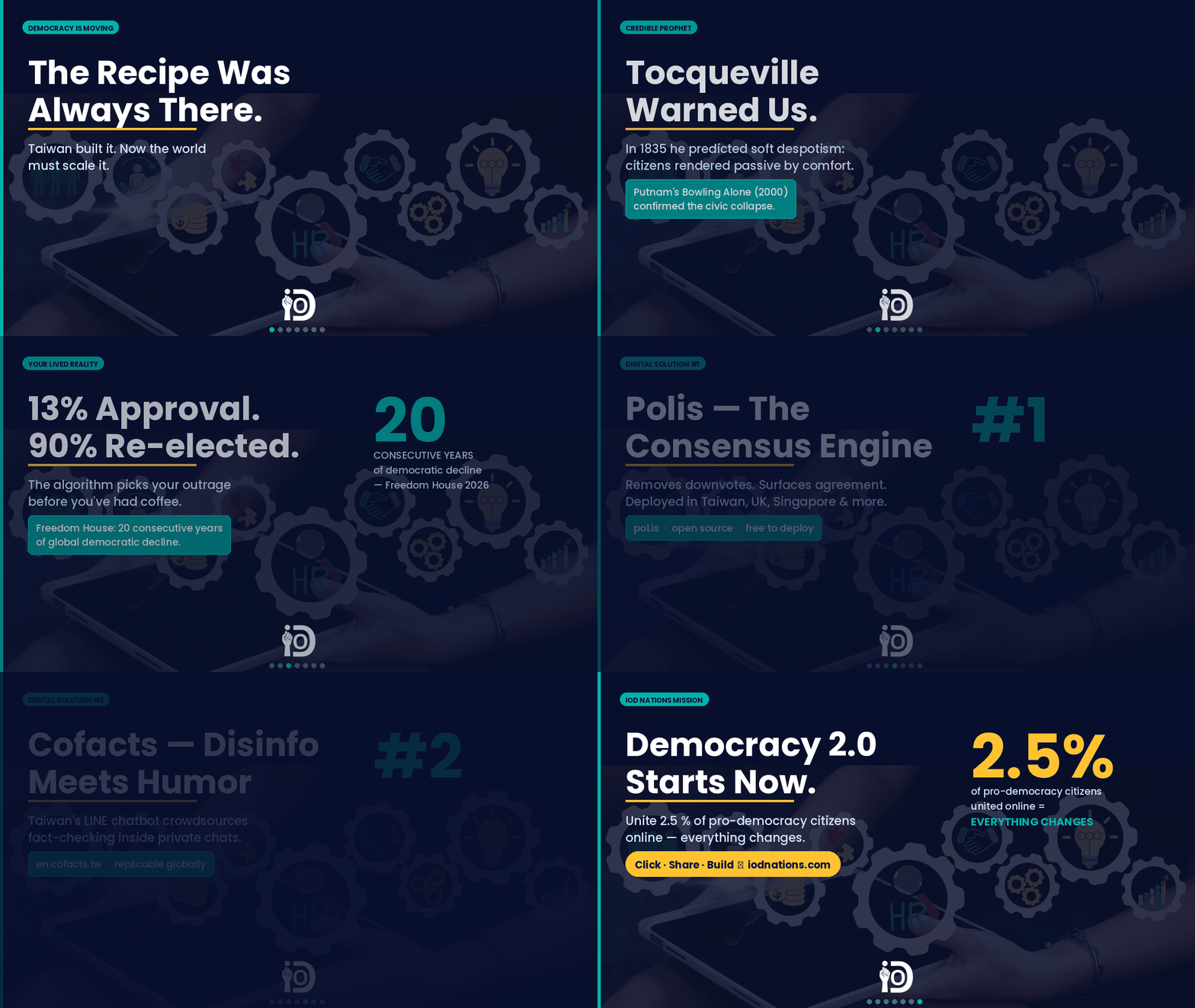
In 1835, a young French political thinker traveled across the young United States and wrote the most accurate diagnosis of democratic fragility ever produced. Alexis de Tocqueville’s Democracy in America identified the precise mechanisms by which self-governing societies destroy themselves from within — not through military conquest, but through the quiet erosion of civic participation.
His warning was surgical
The health of a democratic society may be measured by the quality of functions performed by private citizens.
He did not warn about tyrants. He warned about apathy. He warned that democracies die when citizens retreat into private life, surrender public responsibility to distant institutions, and allow the habit of self-governance to atrophy. He called this “soft despotism” a condition where citizens are not enslaved but are rendered passive, distracted, and dependent.
Look around.
Two centuries after Tocqueville’s warning, American political scientist Robert Putnam documented the collapse of civic association in Bowling Alone (2000) the precise “soft despotism” Tocqueville predicted. Then came the 2008 financial crisis, which proved that institutions meant to serve citizens could be captured by concentrated wealth without democratic consequence. Then came social media which Tocqueville could not have named but would have immediately recognized: a technology perfectly engineered to atomize citizens, monetize outrage, and make collective self-governance feel impossible.
Tocqueville’s prophecy is complete. The question is whether his prescription is, too.
His prescription was civic life. Association. The deliberate, habitual practice of citizens solving problems together at every scale, from the local to the national. He believed that the most powerful antidote to concentrated power was organized, participatory citizenship.
He just couldn’t have imagined that the platform for that citizenship would be digital.
Taiwan imagined it. And then they built it.
You Already Know This Feeling. You Just Don’t Have a Name for It Yet.
You wake up. You check your phone.
Before you’ve had coffee, an algorithm has already decided what version of the world you will see today. It has selected the stories most likely to make you angry, afraid, or contemptuous of your neighbors. It has decided which politicians to amplify, which facts to surface, and which human beings to reduce to caricatures designed to provoke your reaction.
You didn’t choose this. You didn’t consent to it. But you’re paying for it in attention, in civic energy, in the slow erosion of your belief that anything can change.
This is not an accident. It is a business model.
Now scale that experience across 330 million Americans. Across 1.4 billion Europeans. Across every connected democracy on earth.
In the United States, Congress has a 13–20% approval rating and yet incumbents win re-election at a 90%+ rate. That gap is not confusion. It is the signature of a system where citizens feel their participation is performative rather than consequential. You vote. Nothing changes. You protest. Nothing changes. You post. The algorithm amplifies the outrage, monetizes the engagement, and moves on.
In the United Kingdom, Brexit exposed a country so factionally divided that citizens on opposite sides of the debate shared almost no common information environment not different opinions about the same facts, but different facts entirely.
In Brazil, India, Hungary, Turkey, and the Philippines, elected leaders have used those same algorithmically fractured information environments to consolidate power, dismantle judicial independence, and criminalize dissent all while maintaining electoral legitimacy. This is Tocqueville’s soft despotism arriving not through force but through the feed.
In Germany, the rise of the AfD. In France, the Yellow Vest movement’s collapse into incoherence. In South Korea, mass protests that toppled a president but produced no durable civic infrastructure.
The pattern is identical everywhere: Citizens are angry. Citizens are organized enough to react. But no one has built the infrastructure to convert that energy into sustained democratic participation.
You feel this. You have felt this for years. You scroll past outrage because engaging with it costs you something and produces nothing. You avoid Thanksgiving conversations about politics because the algorithms have made your family members into enemies. You have stopped believing that your voice one voice among millions matters enough to use.
Tocqueville called this the beginning of the end.
Taiwan called it a design problem. And they fixed it.
What Taiwan Built and What Every Democracy Needs Now
In 2014, Taiwan was where you are now.
A government had pushed through a major trade agreement with mainland China without consulting citizens or the legislature. Disinformation was flooding social media. A generational divide was fracturing the electorate. A populist demagogue was rising in the polls. Chinese state actors were running coordinated influence operations targeting elections and referenda.
The 2014 Sunflower Movement led by students who occupied Taiwan’s parliament for 24 days was not just a protest. It was citizens asserting their right to participate in decisions that shaped their lives. It worked. The trade deal was stopped. The government fell. And from that moment, a new generation of civic technologists, hackers, and policymakers committed to building democracy differently.
Taiwan’s response was not to pass better laws. It was not to fact-check harder or protest louder. It was to build new civic infrastructure digital tools designed from the ground up for democratic participation rather than engagement metrics.
The hacker collective g0v (pronounced “gov-zero”) founded on the principles of information transparency, open cooperation, and civic engagement became the engine of this transformation. And Audrey Tang, a civic hacker who later became Taiwan’s first Digital Affairs Minister, became its most visible architect.
This is what they built. This is what works. And this is what IOD Nations is bringing to the world.
Tool #1: Polis | Replacing the Algorithm of Division with the Architecture of Consensus
The American Problem It Solves
Gun control. Immigration. Healthcare. Climate. Every major policy debate in the United States is deadlocked not because citizens have irreconcilable values, but because the platforms where debate happens are engineered to maximize conflict, not convergence.
Twitter/X rewards the sharpest attack. Facebook rewards the most emotionally activating post. Reddit rewards the most tribal in-group signal. The platforms are not neutral arenas. They are conflict machines.
Polis is the opposite.
Developed in the United States and deployed at scale in Taiwan, Polis is a participation platform with one radical design choice: it removes downvotes, direct replies, and all the mechanics that produce pile-ons and tribal signaling. Citizens can only indicate agreement with a statement. They cannot attack, dismiss, or silence.
The result: the platform’s algorithms group citizens by what they agree on, not what divides them. Issues where broad consensus exists across partisan lines rise to the surface. The “low-hanging fruit” of democracy becomes visible.
In Taiwan, vTaiwan (powered by Polis) was used to resolve the regulatory deadlock around Uber, a debate that in the United States became a years-long paralysis of competing lobbies and legislative inaction. Taiwan’s civic tech process produced a negotiated outcome in weeks, with buy-in from drivers, companies, and regulators, because the platform was designed to find agreement rather than perform disagreement.
What this looks like in the USA: Imagine a Polis-powered platform deployed around the opioid crisis, infrastructure investment, or veterans’ healthcare — issues where partisan identity matters less than lived experience. Citizens across the political spectrum who have lost family members to addiction, who drive on crumbling highways, who have veterans in their families they share more than the algorithm allows them to know.
Polis lets them find each other.
What this looks like globally: In the UK, Polis could have transformed the Brexit process surfacing the specific concerns (sovereignty, immigration, economic security, regional identity) that drove the Leave vote with enough granularity to build a policy response that didn’t force a binary choice. In Colombia, it is being explored for post-conflict reconciliation surfacing shared values between communities that armed conflict had made enemies.
Tool #2: Cofacts | Defeating Disinformation Without Censorship
The American Problem It Solves
The United States is in a full-scale epistemic crisis. Not a disagreement about values a collapse of shared reality. Documented disinformation campaigns foreign and domestic have convinced tens of millions of citizens of demonstrably false claims about elections, vaccines, and political violence.
The standard response has been fact-checking. It doesn’t work alone.
Research on the backfire effect confirms what psychologists have documented for decades: confronting a motivated believer with contradicting facts does not automatically change minds. It can trigger defensive reasoning that strengthens the original false belief. This is why every major fact-checking organization in the world is struggling to move the needle on entrenched disinformation.
Taiwan’s g0v civic technologists understood this. Their solution was not to prove people wrong. It was to invite everyone into a conversation about how knowledge works and to make misinformation look absurd rather than threatening.
Cofacts launched in 2016 as the first fact-checking chatbot in Taiwan integrates directly into LINE, Taiwan’s dominant messaging app. When misinformation spreads in private chats, citizens forward it to the Cofacts bot. A crowdsourced community of volunteer editors reviews it and sends back context. The goal is not to declare a winner. It is to open a dialogue about where information comes from and how we evaluate it together.
The Mimetic Weapon: How Taiwan Killed Disinformation with Humor
Taiwan’s government added another layer: the mimetic approach. When a false rumor spread that the government was banning hair products, Taiwan’s prime minister didn’t issue a correction. He released a meme. He joked about his own thinning hair. He made the lie look ridiculous not dangerous.
This strategy meeting disinformation not with authority but with humor and self-deprecation doesn’t require winning the argument. It requires dissolving the emotional activation that makes the lie feel important. The rage economy runs on emotional activation. When citizens laugh, they stop being afraid.
What this looks like in the USA: In 2020, disinformation about mail-in voting suppressed participation in communities where the false belief that “your ballot won’t be counted” was circulating. A community-driven, humor-forward counter-campaign culturally specific, locally trusted would have been more effective than any government press release. The tools exist. The approach is proven. What’s missing is the coordinated infrastructure to deploy it at scale.
What this looks like globally: In Kenya’s 2022 elections, WhatsApp disinformation drove ethnic tension. In the Philippines, coordinated Facebook campaigns manufactured a false historical record. In India, mob violence has been triggered by false rumors in WhatsApp groups. In every case, the disinformation succeeded because it activated fear and group identity before any correction could reach the same audience. Cofacts’ open-source model has already been replicated in Thailand it can be replicated everywhere.
Tool #3: vTaiwan | Structured Civic Deliberation That Produces Real Policy
The American Problem It Solves
The United States has no neutral, structured process for citizen deliberation on contested policy issues. What exists is: lobbying (controlled by money), town halls (controlled by incumbents), and social media (controlled by algorithms). None of these produce policy that reflects what citizens actually want.
vTaiwan is an open consultation process that walks citizens, civil society organizations, government officials, and domain experts through a structured sequence: define the issue → gather opinions via Polis → identify consensus → hold a publicly-streamed deliberation → produce policy recommendations.
The results are documented: over 80% of vTaiwan deliberations have led to decisive government action. Not advisory recommendations gathering dust. Actual policy.
What this looks like in the USA: Imagine a vTaiwan-style process convened around the regulation of artificial intelligence an issue where no single political party has a coherent position, where industry, workers, consumers, and civil rights advocates all have legitimate stakes, and where the status quo of no regulation serves almost no one. A structured, transparent, publicly-streamed citizen deliberation with outcomes fed directly to Congressional committees would produce more legitimate policy than any combination of industry lobbying and partisan positioning.
What this looks like globally: Germany’s Liquid Democracy experiments and France’s Citizens’ Convention on Climate have shown that citizens, when given a structured process and real information, produce serious, actionable policy recommendations. vTaiwan is the digital infrastructure that makes that process scalable, transparent, and repeatable not a one-time experiment but a permanent feature of democratic governance.
Tool #4: Crowdsourced Civic Monitoring | Turning Citizens into the Government’s Nervous System
The American Problem It Solves
Flint, Michigan. Jackson, Mississippi. East Palestine, Ohio. In each case, citizens knew something was wrong they could smell it, see it, taste it before any official acknowledgment arrived. The lag between citizen observation and government response cost lives.
In Taiwan, the New Power Party partnered with civic technologists to build affordable, DIY air quality sensors. High school students assembled them in class. The sensors were distributed across communities. Citizens became the infrastructure of environmental monitoring crowdsourcing data that no government agency had the capacity or, in some cases, the political incentive to collect.
This is civic tech at its most democratic: giving citizens the tools to document their own reality and make it undeniable.
What this looks like in the USA: Imagine a network of citizen-deployed water quality sensors in the communities downstream from industrial agriculture in Iowa, or in the fence-line communities adjacent to petrochemical plants in Louisiana’s Cancer Alley, or in the tribal nations where federal environmental monitoring has historically been absent. The data exists it is just not being collected by anyone with the incentive to collect it honestly.
IOD Nations’ vision of the IOD Climate Nation is precisely this: a coordinated, transnational network of citizens using affordable technology to document environmental reality, share data across borders, and create accountability that no single government can suppress.
Tool #5: The Physical-Digital Bridge — Reaching the Citizens Platforms Miss
The Critical Flaw Every Digital Democracy Movement Must Solve
Every participatory digital platform in Taiwan, in Germany, in the United States over-represents the already-engaged: educated, digitally connected, economically stable citizens who have the time and tools to participate.
The citizens most affected by democratic failure, the economically precarious, the digitally excluded, the elderly, the incarcerated, and the rural are systematically absent from digital civic spaces.
Taiwan solved this with a hybrid model. Audrey Tang and her team did not build a platform and wait for citizens to come. They traveled. They brought the technology to city halls, community centers, and senior centers. They streamed the conversations back to policymakers in Taipei. They created physical spaces in Taipei where food, community, and democratic participation happened simultaneously — across generations.
This is the IOD Nations principle in action: democracy is not a website. It is a practice. The digital infrastructure must be embedded in physical community life to reach the citizens who matter most.
What this looks like in the USA: The United States has 14,000 public libraries. It has 90,000 public schools. It has community health centers, faith communities, union halls, and barbershops that function as civic infrastructure for communities the internet has not reached or has actively harmed.
An IOD Nations deployment in the United States doesn’t start with an app. It starts with trusted community institutions hosting structured civic conversations, feeding input into digital platforms, and streaming outcomes back to decision-makers. The technology is the amplifier. The community is the foundation.
The IOD Nations Mission: This Is the Moment
Freedom House documents 20 consecutive years of democratic decline. Today, just 21% of the world’s people live in countries rated Free down from 46% two decades ago.
The tools to fight back exist. Taiwan tested them. They work.
What does not yet exist is the global infrastructure to deploy them the International Online Democratic Nations that can coordinate civic tech deployment across borders, share mimetic counter-disinformation strategies across language and culture, connect the IOD Climate Nation with the IOD Health Nation with the IOD Education Nation in a unified architecture of citizen power.
Tocqueville warned us that democracy requires the active, habitual participation of citizens. The internet was supposed to make that participation easier. Instead, it made apathy more comfortable and outrage more addictive.
Taiwan showed us it doesn’t have to work that way. Design is a choice. Participation is a choice. Democracy 2.0 is a choice.
— Buckminster FullerBuild a new model that makes the previous models obsolete.
IOD Nations is the architecture to take it global.
The recipe exists. The ingredients are citizens. The only missing step is the decision to cook.
Click. Share. Build. The table is set. Democracy 2.0 starts now.
IOD Nations is a citizen-led global movement uniting pro-democracy citizens through International Online Democratic Nations cause-based, borderless, self-governing communities designed to protect, expand, and evolve world democracy in the Internet, Communications and AI Age. Learn more in The Recipe by Joel Koman.