Taiwan didn’t just build the engine of the AI revolution. It built the blueprint for governing it.
IOD Nations is a pro-democracy organization driving ONLINE Citizen-Led Democracy with this simple truth… “If a business no longer requires brick and mortar then a Nation no longer requires land and borders!” The movement is built on a simple premise: democracy is never stagnant, it’s either growing or shrinking. IOD Nations exists to keep it moving forward by putting civic power directly in the hands of citizens through digital tools. Digital participation isn’t optional. Let’s not just save democracy, let’s launch the next bold democracies, at the tap of our screens!
While the rest of the world debates what to do about artificial intelligence regulating it, fearing it, racing past it one small island has already answered two of the most urgent questions of our time: How do we build it responsibly? And who gets to decide?
The answer from Taiwan is clear: citizens do.
The Physical Backbone of AI Lives on One Island
Here is a fact that should stop every government, every tech executive, and every citizen in their tracks.
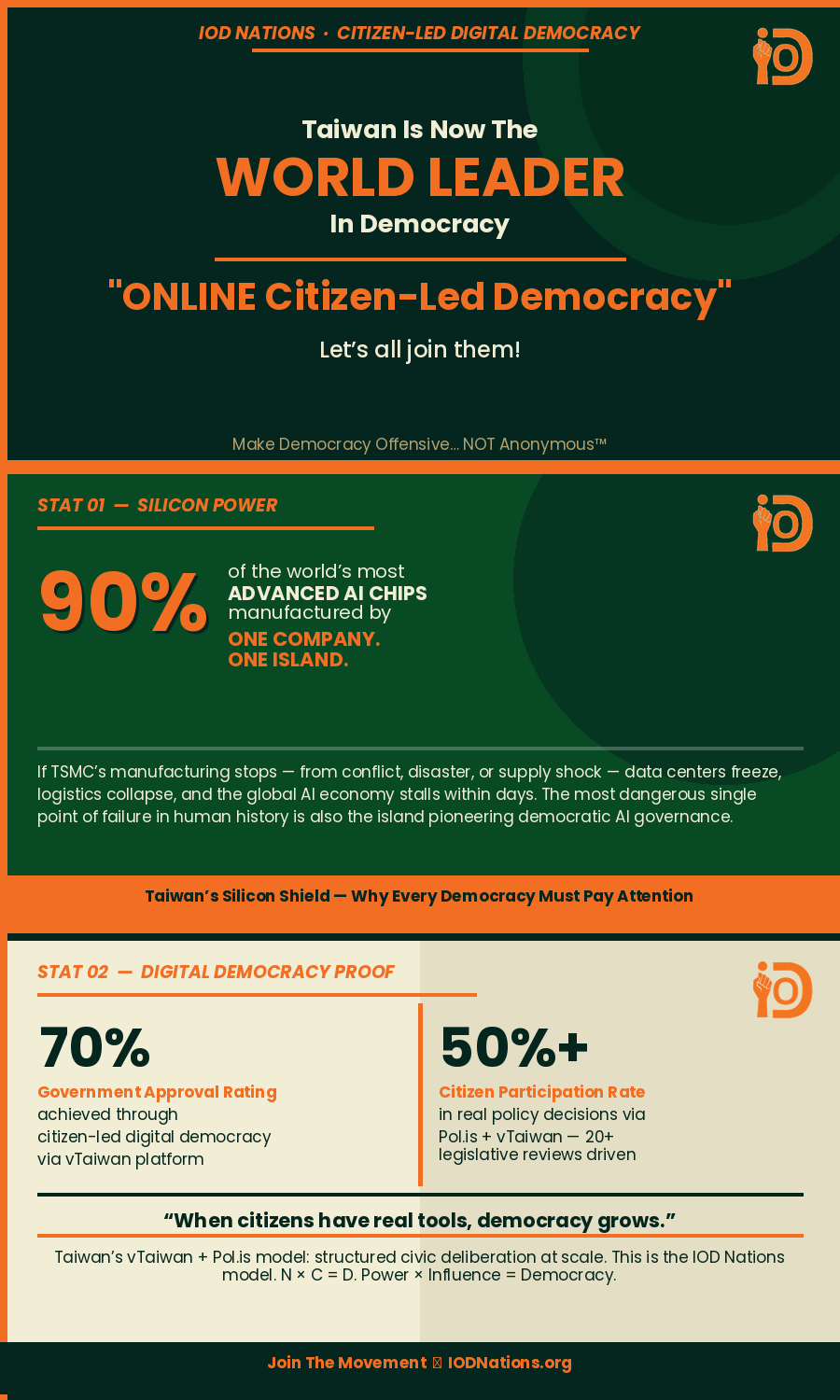
Ninety percent of the world’s most advanced semiconductors are manufactured by a single company, on a single island. So is the worlds most advanced ONLINE Citizen-Led Democracy
Taiwan Semiconductor Manufacturing Company (TSMC) is not just a business. It is the physical bedrock of the global digital economy. Every AI model running on a data center, every autonomous vehicle processing sensor data, every smartphone in a billion pockets all of it depends on chips that can only be produced at sub-7 nanometer precision, using extreme ultraviolet (EUV) lithography machines built by a single Dutch company, ASML, that no other firm in the world has the patents or capability to replicate.
If Taiwan’s manufacturing node goes offline from conflict, natural disaster, or supply chain collapse the effects are not gradual. They are immediate. Data center expansion plans freeze. Global shipping logistics paralyze. Automotive manufacturing lines stop. Consumer electronics prices spike. The interconnected systems of the modern world begin to unravel within days.
This is not a distant risk scenario. It is the live condition of our global civilization.
The cause is structural. In 1987, TSMC founder Morris Chang made a historic decision: decouple chip design from chip fabrication. Companies like Apple and Nvidia could focus on design. TSMC would absorb the colossal capital risk of building and maintaining the fabs. The division of labor was financially brilliant and geographically catastrophic. Physical manufacturing consolidated onto a single island at one of the world’s most volatile geopolitical fault lines.
This concentration is known as the Silicon Shield the theory that global economic dependence on Taiwan’s chips creates a powerful deterrent against regional invasion. The entire world economy has an incentive to keep Taiwan intact.
But a shield built on dependency is not sovereignty. It is leverage. And leverage can shift.
Taiwan’s Answer: Govern AI Before It Governs You
Taiwan did not stop at building the hardware. It moved to govern the software of civilization itself the rules, rights, and responsibilities that determine how AI is built, deployed, and controlled.
On December 23, 2025, Taiwan’s Legislative Yuan passed the Artificial Intelligence Basic Act landmark legislation that establishes the foundational legal framework for AI governance in the Republic of China. It went into effect on January 14, 2026.
This was not a rushed reaction. It was the result of nearly two years of extensive public consultation, stakeholder debate, and democratic deliberation beginning with a draft published by Taiwan’s National Science and Technology Council (NSTC) in July 2024 and refined through a 60-day public consultation process open to citizens.
The Act codifies seven core principles that will govern all AI development and deployment in Taiwan:
Sustainable development and well-being — AI must improve lives and serve social and environmental goals
Human autonomy — citizens retain agency; AI serves people, not the reverse
Privacy protection and data governance — data rights are structural, not optional
Cybersecurity and safety — protection is built in, not bolted on
Transparency and explainability — citizens have the right to understand how AI decisions are made
Fairness and non-discrimination — benefits of AI must be distributed equitably
Accountability — someone is always responsible
The Act designates the Ministry of Digital Affairs (MODA) as the primary implementing agency and mandates the development of an internationally aligned AI risk classification framework. High-risk AI applications must be labeled. Government AI systems must undergo risk assessments within six months of the Act taking effect. Within two years, existing laws must be reviewed and amended to conform.
Taiwan aligned its AI definition and framework closely with the EU AI Act not to follow Europe, but to ensure cross-border compatibility and global regulatory credibility. This is not a small country trying to keep up. This is a sovereign digital nation setting international standards.
The Deeper Blueprint: Citizens Governing Technology
Here is where Taiwan’s contribution becomes revolutionary and where it connects directly to the future of democracy itself.
Taiwan did not only pass a law. Taiwan built a process for citizen-led governance of technology. That process is called vTaiwan.
Launched after the 2014 Sunflower Movement when students occupied parliament to protest a trade agreement rushed through in under a minute without public deliberation — vTaiwan is a digital platform that brings citizens, government officials, and civil society into genuine co-governance of policy.
Using open-source tools including Pol.is a software platform that maps consensus and identifies divisions across large groups of participants vTaiwan has facilitated over 20 legislative reviews. It turned a regulatory dispute over Uber into a negotiated, consensus-based framework. It hosted deliberations on AI governance that produced actionable public recommendations: open-source AI systems should be encouraged; ethical concerns including training data and source code should be publicly accessible; AI systems must have higher cultural sensitivity from development through deployment.
These were not surveys. They were governing decisions made by citizens.
Taiwan’s digital democracy model has achieved something most governments consider impossible: it raised government approval ratings to 70% and achieved over 50% citizen participation in policy decisions by designing digital tools that foster agreement rather than polarization.
The lesson is not subtle. When citizens are given real tools to participate in real decisions, they do. And democracy gets stronger.
Now, the vTaiwan community is turning that same participatory infrastructure directly toward AI governance running public deliberations on how AI should be developed, regulated, and deployed, and feeding those results into the legislative process.
What Taiwan Proves | And What the World Must Learn
Taiwan’s story is a two-part lesson that no democracy can afford to ignore.
Part one: The physical infrastructure of AI is dangerously concentrated. One island. One company. One geopolitical fault line. The world built a multi-trillion-dollar digital economy on a foundation that a single conflict, a single natural disaster, or a single political miscalculation could shatter. Every nation that has not yet developed a sovereign semiconductor strategy is operating on borrowed time and borrowed chips.
Part two: The governance of AI cannot be left to governments alone, and certainly not to corporations. It requires citizens. It requires structured, scalable mechanisms for public deliberation and democratic input not as a courtesy, but as a structural requirement. Taiwan proved this works. The tools exist. The only missing variable is political will.
The IOD Nations Connection: This Is the Model
At IOD Nations, we have been saying this for over 10 years: democracy is either growing or shrinking. It is never static.
AI is the most powerful acceleration force in human history. It will either be governed democratically with citizens at the center or it will be governed by concentrated power: by monopolies, by authoritarian states, by whoever controls the chips and the models and the data.
Taiwan showed us both dangers and both solutions simultaneously.
The danger of physical concentration without democratic accountability 90% of the world’s advanced chips in one place, with no public voice in that decision
The power of citizen-led governance a structured digital democracy model that moved AI regulation from corporate boardrooms and government ministries into public deliberation
This is the IOD Nations mission made manifest. We don’t need land to build a democratic nation. We need citizens with tools, voice, and structural power. Taiwan built those tools. Now every democracy-aligned citizen in the world needs to demand they be scaled.
The formula has always been simple: N × C = D. Numbers (of people) × Collaboration (effective) = Democracy.
Taiwan has the chips. It also has the beginnings of International ONLINE Democracy via their existing, proven, readily available online programs and platforms.
The question is whether the rest of the world has the courage to use it.
IOD Nations is a citizen-led digital democracy movement uniting pro-democracy citizens across borders. Join the movement at IODNations.org.
“Make Democracy Offensive… NOT Anonymous™️”