The Hidden Economic Disaster Behind the Iran War
— Joel Koman, Founder, IOD Nations“Democracy is never stagnant. It’s either thriving or dying.”
IOD Nations is a pro-democracy organization driving Citizen-Led Online Democracy with this simple truth…
“If a business no longer requires brick and mortar then a Nation no longer requires land and borders!”
The movement is built on a simple premise: democracy is never stagnant, it’s either growing or shrinking. IOD Nations exists to keep it moving forward by putting civic power directly in the hands of citizens through digital tools. Digital participation isn’t optional. Let’s not just save democracy, let’s launch the next bold democracies, at the tap of our screens!
By Joel Koman | IOD Nations
Every American needs to read this. Not as a partisan talking point. As an economic emergency.
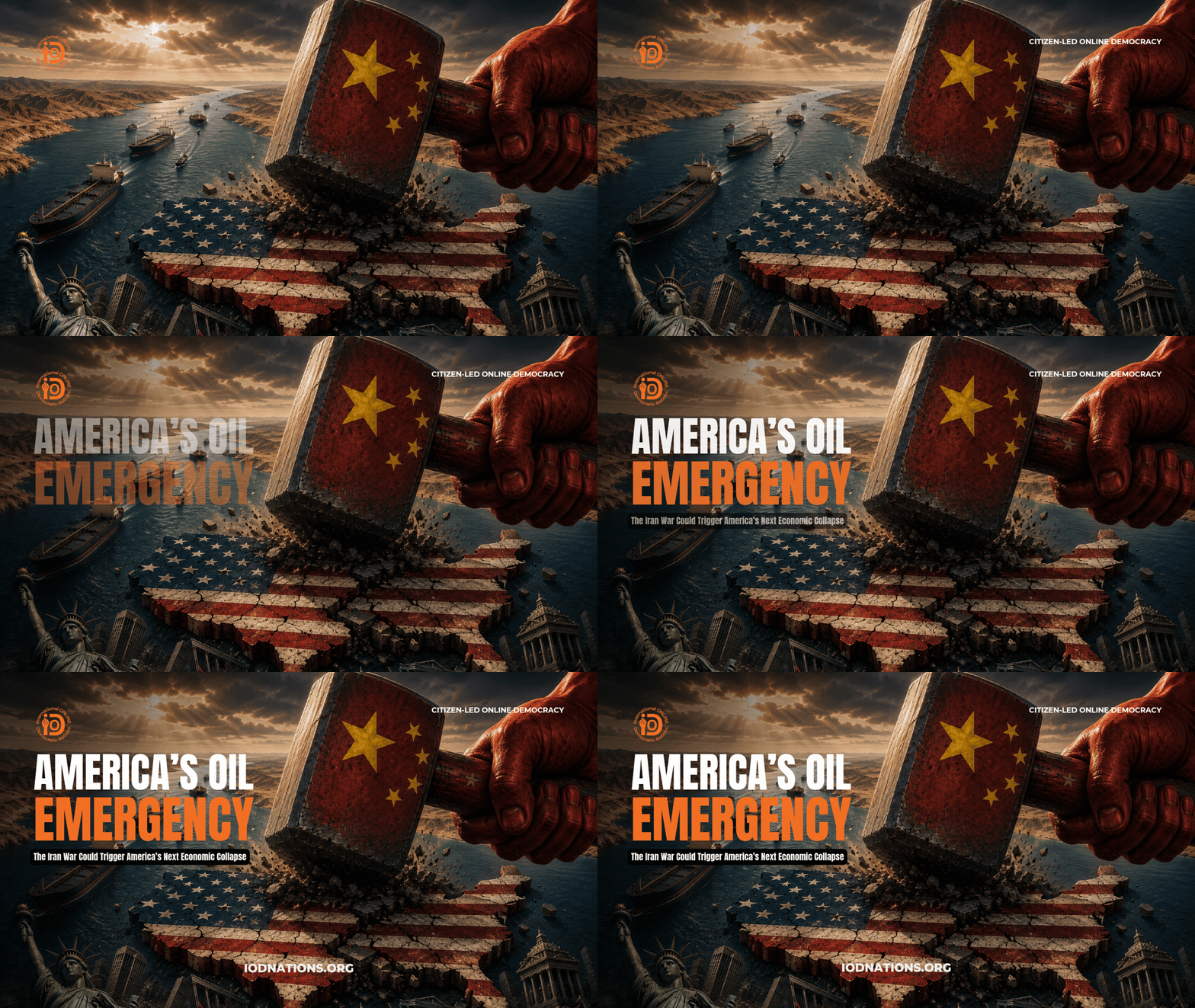
The United States Strategic Petroleum Reserve (SPR) the nation’s emergency oil cushion against exactly this kind of geopolitical crisis is sitting at its lowest levels since 1984. A war started without a single Congressional vote. A critical global waterway blockaded. And China America’s chief economic rival holding more cards than the American public has been told.
This is not a foreign policy story. This is a story about whether your economy survives the next six months.
The Reserve Is Already Depleted | Before the Full Storm Hits
Let’s start with the number that should be on every front page.
At the end of 2025, the U.S. Strategic Petroleum Reserve held only 413 million barrels of crude oil the lowest level since 1984, down from a 2009 peak of 726.6 million barrels. The SPR was designed to hold 714 million barrels. America is running at less than 58% of its emergency capacity.
To put this in stark perspective: as of March 2025, that inventory represented only about 19 days’ worth of oil at current U.S. consumption levels of 20.275 million barrels per day.
Now add a war.
Beginning on March 4, 2026, Iranian forces declared the Strait of Hormuz “closed,” threatening and carrying out attacks on ships attempting to transit the Strait. The result? The oil market has lost approximately 10 million barrels per day of exports from the Persian Gulf, the largest oil supply disruption in history, equivalent to about 10% of total global consumption.
The International Energy Agency’s own head described this as “the greatest global energy security challenge in history.”
The SPR, already dangerously thin, is now the last line of economic defense for 330 million Americans.
What a Closed Strait of Hormuz Actually Means for You
The Strait of Hormuz is not just an oil route. Roughly 27% of the world’s maritime trade in crude oil and petroleum products passes through it. Additionally, 20% of global liquefied natural gas (LNG) trade flows through it along with helium, fertilizers, and other critical industrial products.
When that strait closes, the economic shockwave is not contained to the Middle East. It hits your grocery store, your gas pump, your job.
The data is already in:
Oil prices surged 10–13% to $80–82 per barrel within days of the closure, with analysts forecasting prices could reach $100 per barrel if disruptions persist.
Gas prices in the U.S. have risen $1.16 per gallon since the start of the war, with prices expected to hit $5.00 per gallon if the Strait is not reopened by mid-April.
Fertilizer prices have already spiked — urea prices at the New Orleans hub jumped from $475 to $680 per metric ton. One-third of global fertilizer trade transits the Strait of Hormuz. This will hit U.S. corn and soybean farmers directly during the critical spring planting window.
Jet fuel has spiked 95% since the war began. Multiple airlines have already added surcharges. Shipping services including USPS, Amazon, and FedEx implemented fuel surcharges.
Major global maritime shipping companies Maersk and Hapag-Lloyd have already suspended Middle East routes. Supply chain experts warn that inland port disruption will escalate within weeks as diverted containers arrive in clusters and terminal congestion rises.
The Atlantic Council put it plainly: if the Strait of Hormuz does not reopen soon, the world will almost certainly face a major oil supply crisis, forcing painful, sustained reductions in demand.
China Is Pulling Strings And Has Been for Years
Here is the dimension the mainstream conversation keeps sidestepping: China’s fingerprints are all over this crisis.
China is Iran’s economic lifeline. China buys more than 80% of Iran’s oil exports purchasing approximately 1.38 million barrels per day from Iran in 2025, accounting for 12% of China’s total crude oil imports. Without China as a buyer, Iran’s oil economy — and with it, much of its political leverage collapses. China does not just buy Iranian oil. China sustains Iran.
China also prepared for this crisis before it happened.
In the first two months of 2026, Beijing accelerated crude imports by 15.8% compared to a year earlier. Iranian crude loadings hit a record high of 3.78 million barrels per day in the week of February 16 more than double the previous weekly average. China was building its stockpile while the crisis was building.
The result? China held 1.4 billion barrels in its strategic oil reserve as of December 2025 the largest in the world. That is enough to cover roughly four months of net crude import demand. The U.S. reserve, meanwhile, covers fewer than 50 days of imports at current levels.
China entered this crisis with a fortress. America entered it with a nearly empty vault.
China’s diplomatic double game:
Even U.S. Treasury Secretary Scott Bessent acknowledged the reality on live television: “China has a much bigger interest in reopening the strait than the U.S. does” because nearly all of Iran’s crude oil exports go directly to China.
But Brookings analysts found the more troubling truth: China is providing Iran with indirect support intelligence and dual-use materials while refraining from providing lethal assistance. Beijing has kept a low profile while keeping Tehran economically viable. China also vetoed a U.N. Security Council resolution proposed by Bahrain and supported by Gulf states that aimed to protect commercial shipping through the Strait of Hormuz.
Meanwhile, Iran and China are explicitly using this crisis to challenge U.S. dollar hegemony in global oil markets. About 80% of global oil transactions are settled in U.S. dollars. If that changes, American economic power changes with it.
Even as the Strait remained closed to the world, Iran continued shipping oil through it exclusively to China. The blockade was selective. China was exempted.
The strategic picture is unavoidable: China’s relationship with Iran gave it the leverage to weather this crisis while America burns through its last reserves.
The Root Cause: An Illegal War, No Congressional Vote, and GOP Complicity
None of this had to happen this way.
Under the War Powers Resolution, a president must seek Congressional authorization within 60 days of initiating hostilities or end the conflict. The 60-day mark arrived May 1, 2026. Trump’s response? He claimed the War Powers Resolution is unconstitutional and declared that hostilities had “terminated” despite an active U.S. naval blockade of Iranian ports.
Senator Adam Schiff was direct: “In my view, this war was illegal from the start, because there was no attack on the United States, there was no imminent threat of attack.”
Senate Democrats attempted to pass a war powers resolution six times. Six times, Republicans blocked it. Senate Majority Leader Schumer stated: “This is an illegal war and every day Republicans remain complicit and allow it to continue is another day lives are endangered, chaos erupts, and prices increase, all while Americans foot the bill.”
As Representative Adam Smith, ranking Democrat on the House Armed Services Committee, put it plainly: “Is the expectation that the Trump administration is going to follow the law? I do not have that expectation.”
There is also a financial scandal embedded in this crisis. A Financial Times investigation found that $580 million in bets on falling oil prices were placed just 15 minutes before Trump announced a postponement of Iran strikes on March 23, 2026. A second suspicious series of bets, worth $950 million, were placed just before a policy shift was announced on April 7. A third series of bets worth an estimated $750 million were placed 20 minutes before Iran’s foreign minister announced the Strait would open. The word for that is insider trading — and it demands a full, independent investigation.
The GOP had every constitutional mechanism to demand a Congressional vote, impose limits, or stop this. They chose complicity over accountability. And Americans through their energy bills, their grocery bills, and their economic security are paying the price.
What This Means for Democracy And Why IOD Nations Matters Right Now
“Democracy is never stagnant. It’s either thriving or dying.” — Joel Koman
What you are watching in real time is what happens when democratic accountability breaks down.
A president launches a war without a Congressional vote.
The party in power blocks every legal check six consecutive times.
A foreign adversary with deep influence over a geopolitical flashpoint — has more strategic reserves, more diplomatic leverage, and a clearer long-term plan than the government that claims to represent you.
And ordinary citizens, with no seat at the table where these decisions are made, are left to pay $5 at the pump and wonder what happened.
This is not just an oil crisis. This is a democracy crisis.
The solution is not to wait for the next election and hope the right people show up. The solution is to build the infrastructure of citizen power now — before the next crisis, before the next unilateral decision, before the next secret bet on falling prices.
IOD Nations exists for exactly this moment.
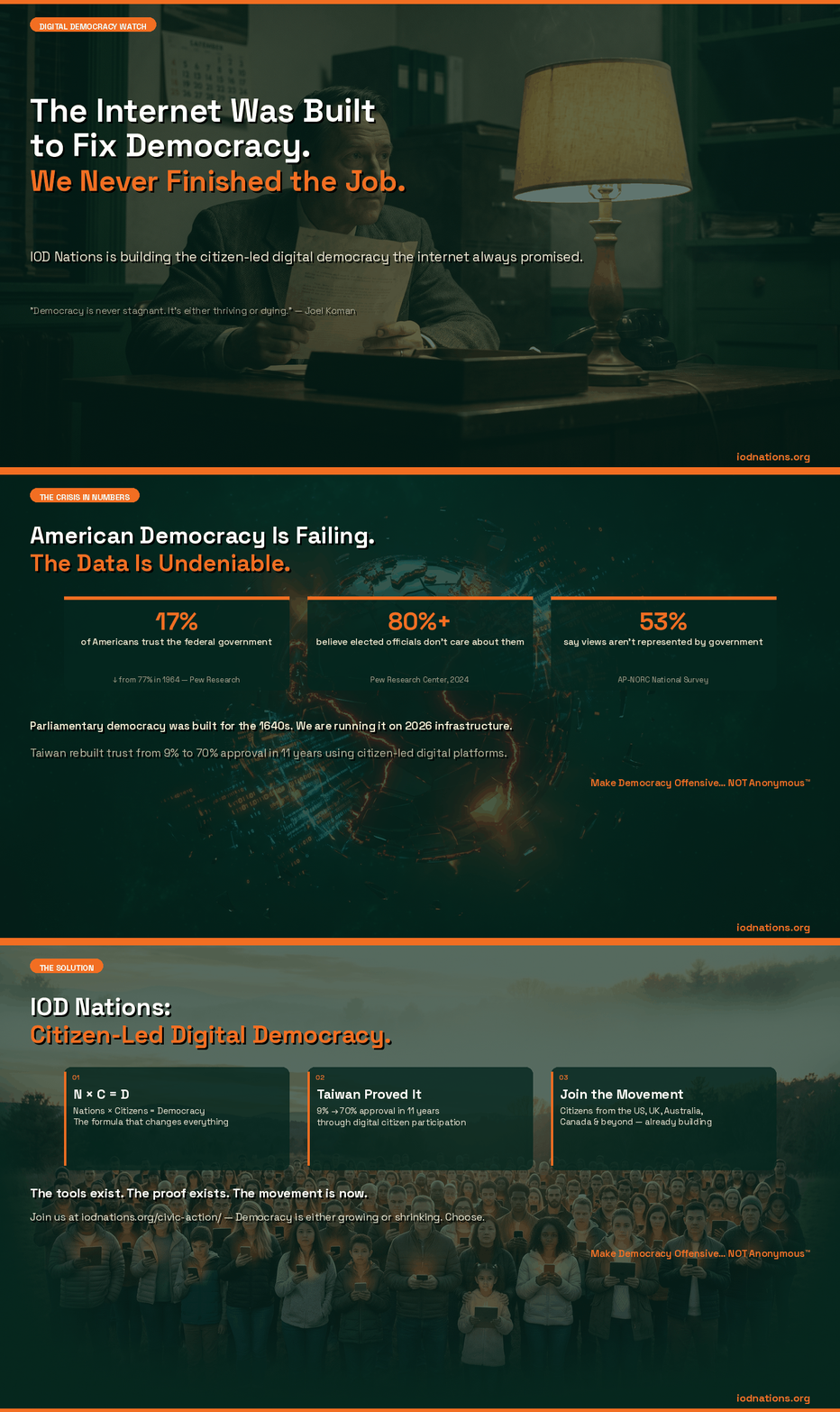
We are building the world’s first citizen-led online democratic movement — modeled on Taiwan’s proven vTaiwan/Pol.is system, where citizens don’t just vote every four years, they govern continuously. Where movements don’t wait for politicians to act — they act together, online, across borders, in real time.
The formula is simple: N × C = D. Numbers × Civic Action = Democratic Power.
The Question You Have to Answer
Would you join one million citizens demanding democratic accountability over decisions that cost you at the pump, at the grocery store, and in your national security?
That is the one simple question IOD Nations asks.
→ Explore our mission: IODNations.org
→ Take your first civic step today: iodnations.org/civic-action/
Democracy doesn’t maintain itself. It needs your voice — now more than ever.
Sources: