
Out-Memeing the Patriarchy: How to Build a Democracy That Actually Listens

— Joel Koman, Founder, IOD Nations“Democracy is never stagnant. It’s either thriving or dying.”
Our Mission: The Democratic Commons
IOD Nations exists to prove one idea: if a business no longer requires brick and mortar, a nation no longer requires land and borders.
We call this framework The Democratic Commons — a structure in which every ONLINE Citizen-Led Democracy, whether Cause-Based (united by shared purpose, open to the world) or Geographic (rooted in land and borders, built for continuous direct participation), is sovereign, distinct, and self-governing. Every one of these nations is united by a single shared purpose: to protect, expand, and improve world democracy.
One citizenship. One platform. Infinite entry points.
As Buckminster Fuller put it: “You never change things by fighting the existing reality. To change something, build a new model that makes the existing model obsolete. Dare to be naive. We are intended to be architects of the future, not its victims.”
Our formula is simple: N × C = D — Nations times Citizens equals Democracy. The more sovereign, self-governing digital nations we build, and the more citizens who show up inside them, the stronger world democracy becomes.
A Note to Readers
We are pleased to offer this article free of charge, as we believe in the importance of sharing knowledge and fostering dialogue around the establishment of citizen-led democratic nations. Any assistance, feedback, or insights you can provide would be greatly appreciated as we embark on this journey. We value your expertise and are eager to collaborate on building our first online citizen-led democratic nation.
This piece is about a specific, urgent question: how do we reach young American women, the demographic most alarmed about the state of democracy, and the demographic most capable of rebuilding it? We look at two unlikely teachers: an Indian meme movement that outgrew a ruling political party in five days, and a Taiwanese cabinet minister who turned an occupied parliament into the blueprint for digital self-government.
Two Proven Models, Built Outside the Old System
Before we talk strategy, we have to establish that the tools exist and that they work.
Taiwan already ran this experiment. After the 2014 Sunflower Movement occupation of Taiwan’s legislature, civic technologist Audrey Tang was appointed the country’s first Digital Minister, tasked with turning street-level protest energy into a working system of digital self-governance (Ash Center, Harvard Kennedy School).
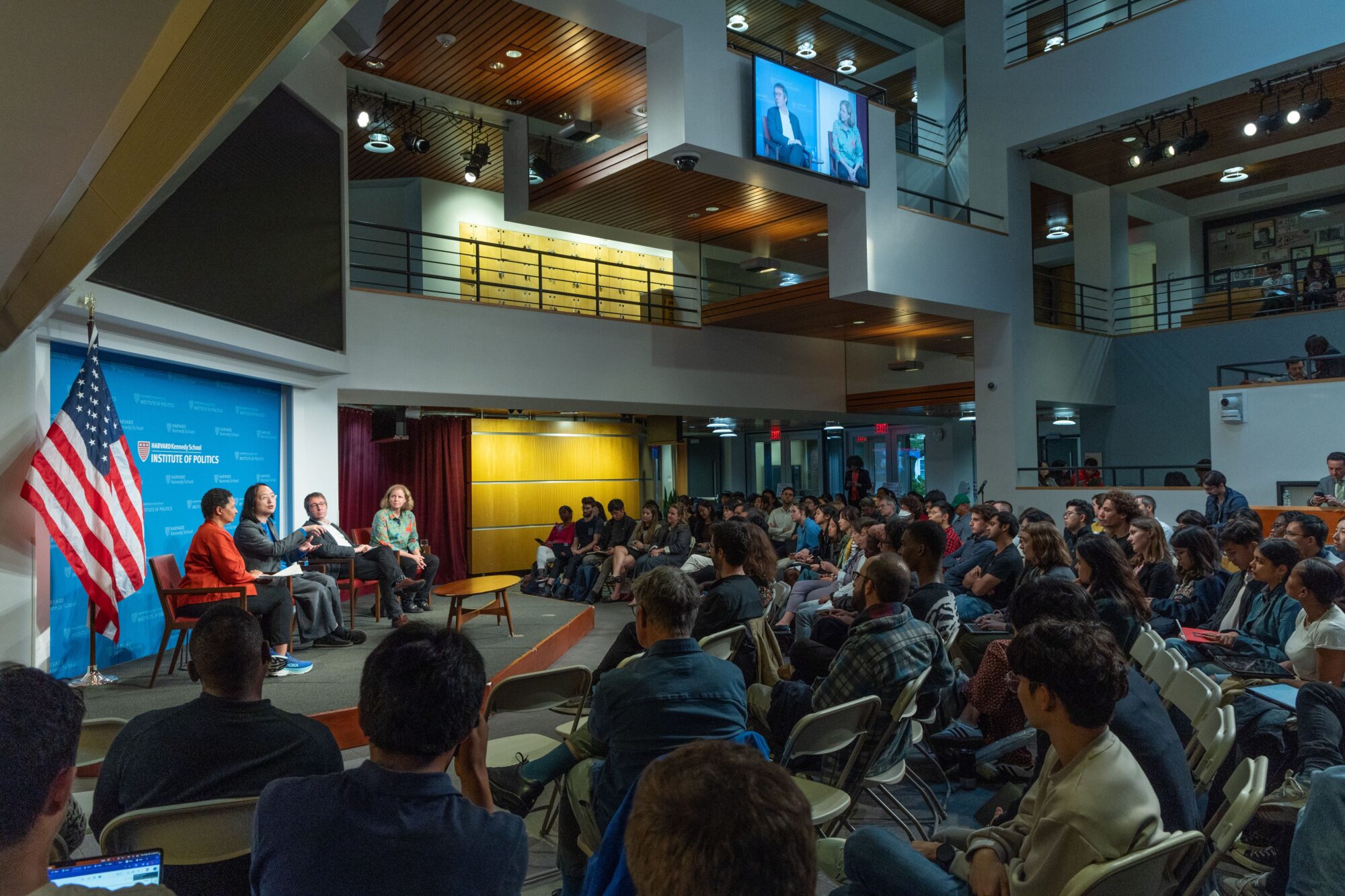
The platform she helped build, vTaiwan, paired crowdsourced fact-finding with a deliberation tool called Pol.is. Of the 26 national issues run through the process, roughly 80 percent led to actual government action (Wikipedia, Pol.is). Tang has since been named to TIME’s “100 Most Influential People in AI,” was awarded the Right Livelihood Award — often called the “Alternative Nobel Prize” — and now advises governments worldwide, including in the United States, on building deliberation tools that reward bridge-building instead of outrage (Right Livelihood; TechPolicy.Press).
India just ran a different experiment — at meme speed. In May 2026, after India’s Chief Justice publicly called unemployed young people “cockroaches,” a 30-year-old political strategist named Abhijeet Dipke turned the insult into the Cockroach Janta Party. Within 78 hours it hit 3 million Instagram followers, and within five days it passed 10 million, overtaking the ruling party’s own account (Wikipedia, Cockroach Janta Party). Within roughly a week it reached about 19 million — more than double the ruling BJP’s own following, and individually larger than either the BJP (~9 million) or the opposition Congress party (~13.4 million) (NBC News).
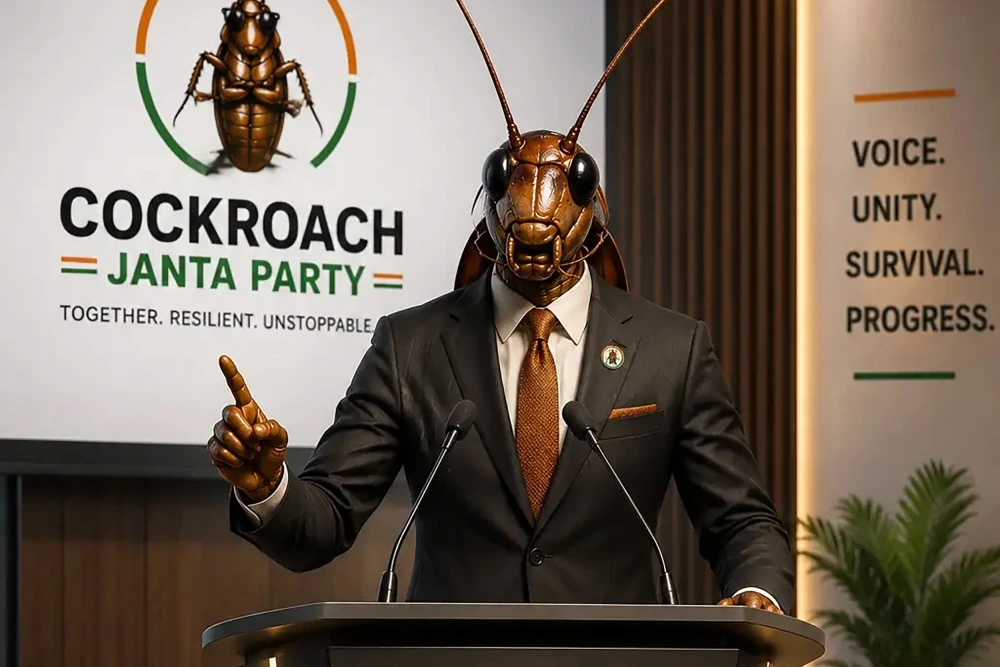
It had no registered party status, no ground infrastructure, and no legacy media backing. What it had was a reclaimed insult, decentralized spokespeople, satire sharp enough to travel, and a real-world protest that followed the online wave rather than trying to manufacture it.
Two very different countries. Two very different tools. One shared lesson: when young people are told they don’t matter, the fastest-growing movements are the ones that hand them the microphone and the architecture at the same time.
Young American Women Are Already Naming the Crisis
This is not a hypothetical audience. Young American women are telling us, in survey after survey, that democracy is the fight they are already in.
Among Gen Z women, threats to democracy is the single most-cited top issue — ahead of the economy, ahead of every other concern polled — while for Gen Z men the top issue is the economy (NBC News / SurveyMonkey poll).
Trust in the federal government among young Americans overall has fallen to just 15 percent, and half now say people like them have no real say in government at all (Harvard Kennedy School Institute of Politics, Spring 2026 Youth Poll).
Across party lines, 84 percent of Americans say democracy is in crisis or facing serious challenges — with younger generations expressing the deepest dissatisfaction with how the system actually functions (SNF Agora Institute, Johns Hopkins).
Young people say the top source they trust for political information is social media posts from advocacy and community organizations they follow — cited by 45 percent, ahead of traditional broadcast news (CIRCLE, Tufts University).
Gen Z women and girls are notably more likely than Gen Z men and boys to find meaningful engagement through social media — while young men more often find that connection through video games (PRRI, Generation Z research).
Read those five findings together and a picture snaps into focus: the audience most worried about democracy is also the audience most reachable through decentralized, organization-led, socially native content — not through another cable news segment or another party press release.
That is not a coincidence. That is an opening.
Build the Bridge Between the Swarm and the System
Democracy dies when people feel unheard and unheard people go silent — or worse, go looking for an authoritarian shortcut that promises to feel heard for them. The Cockroach Janta Party proved that reach can be won in days if you reclaim the narrative and hand the mic to the people being dismissed. Audrey Tang proved that reach without structure just becomes another outrage machine — the deliberation layer is what turns attention into actual policy movement. IOD Nations is built to run both halves of that playbook, together, for young American women specifically.
Here is the model:
1. Reclaim the narrative, CJP-style. Young American women are not short on reasons to be told their concerns don’t matter. The CJP played offense with that dynamic instead of playing defense — a name, a mascot, and a five-demand manifesto that was satire first and policy second, spread by the people it represented, not by a campaign office (Britannica). IOD Women’s Nation (IODWN), our existing Cause-Based sub-nation, is the vehicle for exactly this kind of content: sharp, funny, unmistakably youth-authored, built to travel on Instagram and TikTok the way memes travel — not the way press releases travel.
2. Replace the shouting match with a listening machine, Tang-style. Once attention arrives, most platforms burn it by rewarding whoever shouts loudest. Pol.is does the opposite: no reply button, anonymous input, and an algorithm that promotes only the ideas that bridge disagreement rather than deepen it (Pol.is, Wikipedia). That is the same architecture already at the foundation of IOD Nations’ Democratic Commons model. Our civic action hub exists to give every new arrival — recruited through IODWN content — an immediate, structured way to be heard, not just seen.
3. Decentralize the spokespeople. CJP didn’t rely on one face. It stood up multiple young spokespeople so the movement couldn’t be beheaded by attacking its founder (Al Jazeera). IOD Nations should do the same inside IODWN: real young American women as the public face of outreach, not a single national spokesperson.
4. Meet the trust gap head-on. With federal trust at 15 percent and half of young Americans saying they have no real say, the pitch cannot be “trust the system.” The pitch has to be “build a new system you can actually see and steer” — which is the entire premise of citizen-led, online, sovereign nations under the Democratic Commons.
This is the difference between a protest and a platform. India’s cockroaches proved you can win the feed in a week. Taiwan proved you can turn that attention into governance that actually moves. IOD Nations is where both halves meet — for the young American women who are already telling us, at record numbers, that this is the fight of their generation.
Two Direct Outreach Channels | Not Just Two Case Studies
Studying these two models is step one. Here is how IOD Nations actually opens a line to each of them, rather than simply admiring them from a distance.
Reach out to Audrey Tang directly. Tang is not a closed door. Since leaving office she has become an active public speaker and collaborator — appearing at Harvard’s Kennedy School, Oxford, Harvard Business School, and the Right Livelihood Foundation’s own public panels, and co-authoring the open, community-built book Plurality: The Future of Collaborative Technology and Democracy (Ash Center, Harvard; HBS Institute for Business in Global Society; Right Livelihood). IOD Nations’ concrete ask: an invitation to Tang, through her public speaking and Plurality.net networks, to join an IOD Nations interview or civic-tech panel focused specifically on what a Pol.is-style listening tool would look like built for young American women’s priorities — starting with “threats to democracy” itself, since that is the issue they already rank first.
Engage the Cockroach Janta Party’s audience, not the party. IOD Nations has no affiliation with CJP, which is a domestic Indian movement addressing Indian politics. What we can responsibly do is study and reach the same kind of audience it activated, young, online, dismissed, and ready to organize, by publishing our own American analysis of the CJP phenomenon (like this article) into the same discovery ecosystem: Instagram Reels and TikTok, under the youth-politics hashtags already driving CJP’s own reach, such as #GenZPolitics and #YouthPolitics (source content, Cockroach Janta Party public site). That puts IOD Nations’ message in front of the global cohort of young people already primed by CJP’s example to believe a satirical, citizen-built movement can outgrow an entrenched political establishment in days, not years — and invites them to point that same energy at building an online citizen-led democracy of their own.
Join the Movement
Website: iodnations.org
Civic Action Hub: iodnations.org/civic-action/
IOD Nation Substack Publication: subscribe for ongoing coverage
YouTube: watch our explainer series on the Democratic Commons
Email: hello@iodnations.org
“You see things and ask why. I dream things and ask — Why Not?” — George Bernard Shaw
Make Democracy Offensive… NOT Anonymous™