
N × C = D: The Mathematical Formula for Scaling World Democracy
IOD Nations Mission
IOD Nations is a vision of an undeniable, bold new architecture for world democracy, one that was simply never available to the citizens of the world before the internet. It operates under a single overarching framework: The Democratic Commons. Within it, every ONLINE Citizen-Led Democracy, whether organized around a shared cause or a geographic nation, is sovereign, distinct, and self-governing. What unites them all, without exception, is one unwavering macro-level commitment: the protection, expansion, and improvement of world democracy, for as many people, in as many ways, as possible. IOD Nations consist of two expressions: Cause-Based ONLINE Citizen-Led Democracies, which unite citizens globally around shared purpose regardless of where they live, and Geographic ONLINE Citizen-Led Democracies, which unite citizens of traditional land-and-borders nations in continuous direct democratic participation. One citizenship. One platform. Infinite entry points. All of it is available at the click of a mouse or the tap of a screen.

— Joel Koman, Founder, IOD Nations“Democracy is never stagnant. It’s either thriving or dying.”
“You never change things by fighting the existing reality. To change something, build a new model that makes the existing model obsolete. Dare to be naive. We are intended to be architects of the future, not its victims.”
— Buckminster Fuller
Note to Readers
We are pleased to offer this article free of charge, as we believe in the importance of sharing knowledge and fostering dialogue around the establishment of citizen-led democratic nations. Any assistance, feedback, or insights you can provide would be greatly appreciated as we embark on this journey. We value your expertise and are eager to collaborate on building our first ONLINE Citizen-Led Democratic Nation. Today, we’re studying the one government on Earth that has already proven our model works and asking why America hasn’t built it yet.
The bottom line
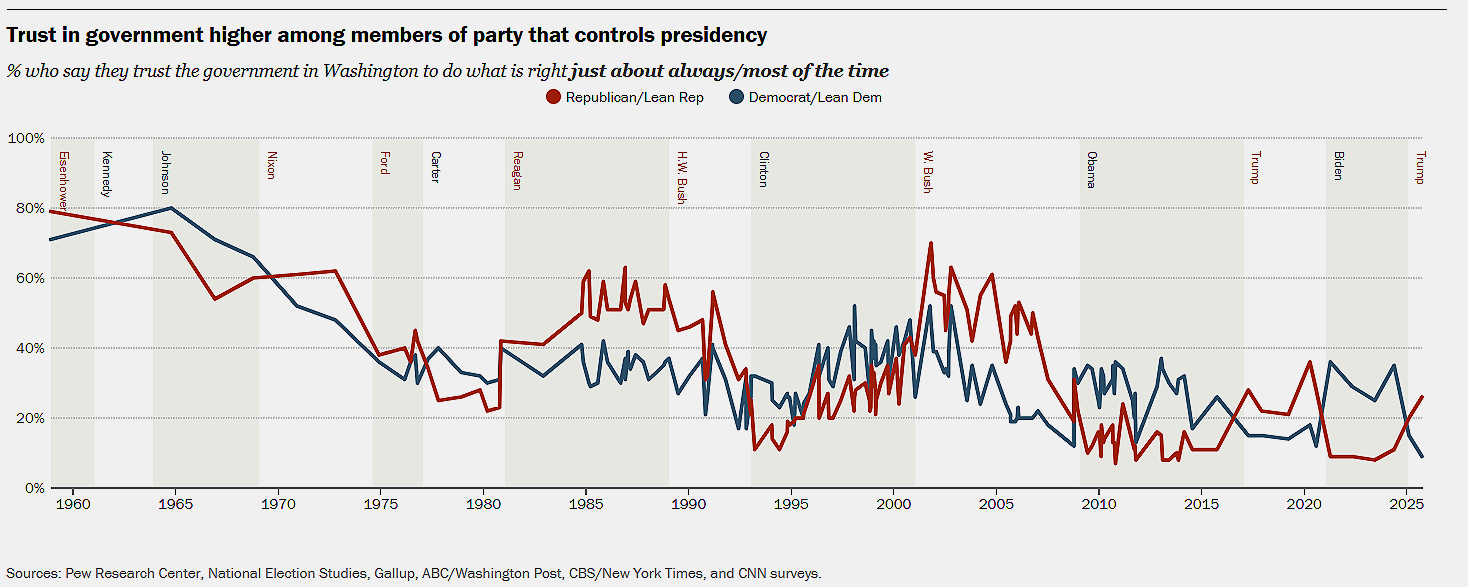
Trust in the U.S. federal government sits at 17 percent, one of the lowest readings Pew Research Center has recorded in nearly 70 years of asking the question.
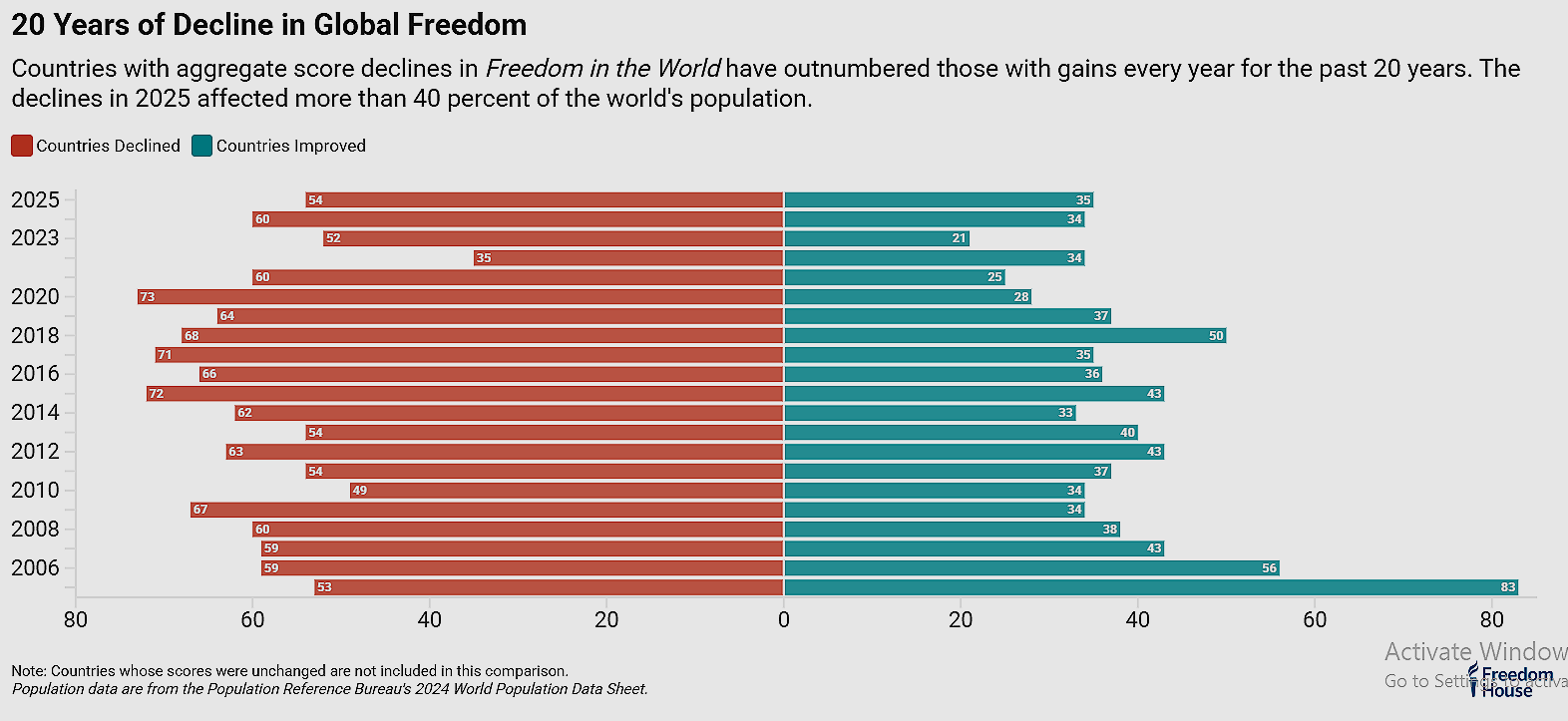
Zoom out further: global freedom has now declined for 20 consecutive years, and the United States tied for the sharpest one-year decline of any country still rated “Free” in Freedom House’s 2026 report.
Meanwhile, 8,000 miles away, a small island democracy took its own trust rating from 9 percent to over 70 percent in six years, not through a new President, a new party, or a new Constitution, but through a new platform. Taiwan built the tools to let citizens govern continuously instead of every four years. It worked. It’s documented. And it’s exactly the model IOD Nations exists to bring to the rest of the world.
Democracy in America is not stagnant; it’s shrinking. Taiwan proves the alternative isn’t theoretical. It’s operational, measurable, and waiting to be built.
From 9% trust to the least polarized nation in Asia
In 2014, Taiwan’s government had a 9 percent approval rating. Citizens occupied the national parliament for three weeks over a trade deal negotiated behind closed doors. A young programmer named Audrey Tang helped livestream the occupation instead of just protesting it, and when the dust settled, the government did something almost no government ever does: it invited the activists in.

Tang became Taiwan’s first Minister of Digital Affairs. Her mandate wasn’t to manage servers; it was to rebuild trust between citizens and the state by making government radically transparent and continuously participatory. The result, in her own words at Harvard Business School: by 2020, trust in Taiwan’s government had climbed from 9 percent to over 70 percent, and it stayed above 60 percent afterward. Today, Taiwan ranks as the least polarized nation it has measured itself against, and the most democratic nation in Asia.
Compare that to the U.S. picture right now: only 33 percent of Americans say they trust the federal government even under the most generous measure, two-thirds call it “corrupt,” and trust swings 20+ points depending purely on which party controls the White House. That’s not a democracy responding to its people. That’s a democracy responding to whoever currently holds power, the opposite of the model.
vTaiwan: the platform that turned protesters into policymakers
The engine behind Taiwan’s turnaround is a citizen consultation process called vTaiwan, built by the civic-tech community g0v in direct response to the 2014 occupation. It runs on open-source software called Pol.is, and it works nothing like a Twitter argument or a town hall shouting match. Here’s the actual mechanism:
Stage 1 — Crowdsourced framing. Citizens, agencies, and affected stakeholders submit facts, questions, and concerns on an issue.
Stage 2 — Opinion mapping. Anyone can post short statements; participants can only agree, disagree, or pass. There is no reply button. Pol.is removes the ability to argue directly with another person’s statement, which is precisely what strips out trolling and flame wars. The software then visually clusters participants by opinion and critically surfaces the statements that win support across opposing clusters. Taiwan calls these “bridging statements.”
Stage 3 — Live deliberation. Stakeholders join a livestreamed, transcribed public meeting to refine the highest-consensus statements into concrete recommendations.
Stage 4 — Government response. The relevant ministry must either enact the consensus as policy or publicly explain, point by point, why it won’t.
The result isn’t a poll. It’s a rough consensus with a paper trail, and it holds government accountable to answer, not just listen.
The proof point: how Taiwan solved the Uber war
When Uber entered Taiwan in 2013, it triggered the same conflict tearing through cities worldwide: gig platform vs. entrenched taxi industry, efficiency vs. worker protection. Taiwan didn’t legislate from the top down. It ran the fight through vTaiwan.
More than 4,500 citizens– Uber drivers, taxi drivers, and passengers of both- voted on 145 competing statements over several weeks. (Case documentation varies on the exact count across stages of the process; some records put initial-round participation closer to 900, with the full four-week engagement reaching over 4,500 and 31,000+ total votes cast.) Uber itself participated in the open conversation, submitting its own analysis in full public view. As the process matured, the extreme positions on both sides lost support, while cross-cutting ideas like requiring the same 5-star safety rating system for every vehicle-for-hire gained backing above 85 percent across every stakeholder group. The recommendations became a real bill. Uber was legalized under seven conditions, while co-ops were empowered to keep serving rural routes that competitors wouldn’t touch. Uber’s own U.S. policy chief later returned to Taipei to respond publicly to the process on the record, on video.
Since launch, more than 80 percent of vTaiwan deliberations have led to concrete government action. Not a suggestion box. A functioning arm of government.
How Taiwan pre-bunks and debunks disinformation before it spreads
The most urgent lesson for American readers isn’t the consensus software; it’s what Taiwan built to protect that consensus from being poisoned by disinformation, and it has two names: pre-bunking and Cofacts.
Pre-bunking means exposing the manipulation technique before the attack lands, so citizens recognize it on sight. Two full years ahead of Taiwan’s 2024 general election, Tang’s team released their own demonstration deepfake videos showing exactly how easy it was to fabricate a video of a government minister, including of Tang herself. By the time real deepfake attacks hit during the actual election, citizens had already built what Tang calls “mental antibodies.” The attacks landed and largely failed to spread.

Taiwan backed this with a hard infrastructure decision: paper-only ballots, hand-counted, with every counting station recorded on video by observers from all three major political parties. When deepfaked “evidence” of vote-rigging inevitably circulated after the election, officials didn’t argue on social media; they pointed directly to the timestamped recordings. All three major parties publicly confirmed the count was clean.
Cofacts is the debunking layer for everyday disinformation, the rumors, scams, and fake health claims that spread through private messaging apps like LINE, where public fact-checkers can’t see them. Built by the same g0v civic-tech community since 2016, Cofacts lets anyone forward a suspicious message to a chatbot; the message enters a shared, open database where volunteer fact-checkers research and respond, and the reply gets sent straight back. The next person who receives the identical rumor gets an instant, pre-researched answer instead of starting from zero. Over 2,000 volunteer editors have fact-checked more than 87,000 suspicious messages, and it’s fully open-source, meaning the same model has already been forked and rebuilt in Thailand.
When AI-generated deepfake scam ads flooded Taiwanese social media in 2024, fake celebrities pitching crypto Taiwan didn’t wait for a lobbying process. It text-messaged 200,000 random citizens, asked how they felt about the threat, then randomly selected 450 people for a one-day structured citizens’ assembly. Their proposal: platforms must verify a person’s digital signature before running an ad using their likeness, and platforms bear financial liability if they don’t. That proposal became binding law within months, and the scam ads measurably declined.
Compare the speed: from citizen text message to enforced regulation, Taiwan moved in under a year. The U.S. still has no comprehensive federal deepfake law.
Why this is a Democratic Commons problem, not just a Taiwan story
Here is the uncomfortable truth for American readers: none of what Taiwan built required a new form of government, a new currency, or a revolution. It required citizens with a platform built for continuous participation instead of a ballot every four years. Every tool Pol.is, Cofacts, the citizens’ assembly model- is open-source. Nothing about it is uniquely Taiwanese. It is infrastructure, and infrastructure can be built anywhere, by anyone, starting today.
This is the exact gap IOD Nations exists to close.
A business no longer needs brick and mortar to operate globally. A democracy no longer needs land and borders to function continuously. IOD Nations is building ONLINE Citizen-Led Democracy, Cause-Based and Geographic as sovereign, self-governing digital nations united under one Democratic Commons, so that the bridging, consensus-building, and rapid-response accountability Taiwan proved possible in one island can scale to citizens everywhere, regardless of the government currently failing to represent them.
Taiwan answered the question of whether digital democracy works. The only open question left is whether the rest of the world builds it or keeps watching trust in twentieth-century institutions bleed out one percentage point at a time.
N × C = D. Nations times Citizens equals Democracy. Taiwan is one nation. Imagine what happens when citizens everywhere build their own.
Join the movement
🌐 Website: iodnations.org
✊ Civic Action Hub: iodnations.org/civic-action
📧 Contact: hello@iodnations.org
📚 Manifesto & Recipe Book — available at iodnations.org
▶️ YouTube — IOD Nations
✍️ Substack — IOD Nation Publication